
To monitor brand mentions, set up automated alerts for your brand name, its common variations and your key people, then check them on a fixed routine. Start with free alerts, add a dedicated monitoring platform once volume grows, and review reviews and social channels by hand. Then decide which mentions you need to respond to and which you can safely ignore.
This guide walks through each step for an Australian business. It covers what counts as a mention, what to track, what it costs, the privacy rules you should respect, and where a press release fits in. If you have wondered whether press releases are worth it, you will find a straight answer in the second half.
TL;DR
- A brand mention is any reference to your company, product or key people on news sites, blogs, forums, social networks or review platforms, linked or not.
- Start with free alerts, then move to a paid monitoring platform when you are drowning in volume or need sentiment and reach data.
- Track narrow, brand-level queries. Tracking everything creates noise and alert fatigue.
- In Australia, avoid collecting personal information from forums and reviews, and share only aggregated, brand-level data with third-party tools.
- A press release is worth it when it carries real news. It creates a dated public record and gives monitoring something to measure, but it does not replace pitching journalists.
Table of Contents
- What counts as a brand mention
- Decide what to track before you pick a tool
- Free ways to monitor brand mentions
- When to move to a paid monitoring platform
- Set up a monitoring routine that gets used
- Privacy: what Australian businesses should watch
- Mentions that matter versus mentions that merely exist
- Are press releases worth it?
- Perspective: how we think about mentions and releases
- Publishing your news on News Today
- A simple 30-day plan
- FAQ
- Sources
What counts as a brand mention
A brand mention is any instance where a company's name, product or key personnel is referenced in online media, social networks, news sites, blogs, forums or review platforms, according to Semrush's documentation on brand monitoring. Some mentions link to you. Many do not, and the unlinked ones are often the most valuable to find.
It helps to sort mentions into four groups, because each calls for a different response:
| Type | Where it appears | What you usually do |
|---|---|---|
| News and editorial | Online news, trade press, industry blogs | Thank the writer, share it, ask for a link if one is missing |
| Customer voice | Reviews, forums, social posts | Reply, fix problems, learn what customers care about |
| Competitive | Comparisons, "alternatives to" lists | Check accuracy, note where you are positioned |
| Self-published | Your own releases, partner posts, directories | Confirm facts are consistent and correct |
The fourth group gets forgotten. If you publish news yourself, those pages are mentions too, and you control their accuracy.
Decide what to track before you pick a tool
Most people open a tool, type their company name and are buried in results within a week. Decide the list first.
Build a keyword list
Start with these:
- Your exact brand name, in quotation marks.
- Common misspellings, abbreviations and nicknames. Semrush's guidance also points to tracking spelling variations and nicknames so coverage is complete.
- Product and service names.
- Founder and spokesperson names (see the privacy section below for how to treat these).
- Two or three competitor names, so you can see where you are being compared.
- A handful of industry phrases where you want to be part of the conversation.
If your brand name is also an ordinary word, add exclusion terms. A bakery called "Sunrise" needs "Sunrise bakery" and your suburb, or you will read about every sunrise in Australia.
Keep it granular
Good monitoring is about smart, specific alerts, not capturing every mention. Practitioners advise limiting active monitoring to brand-level queries and industry-relevant keywords, because too much noise leads to fatigue and ignored inboxes. Ten sharp alerts you read beat a hundred you mute.
Free ways to monitor brand mentions
You can cover the basics without spending anything.
Google Alerts
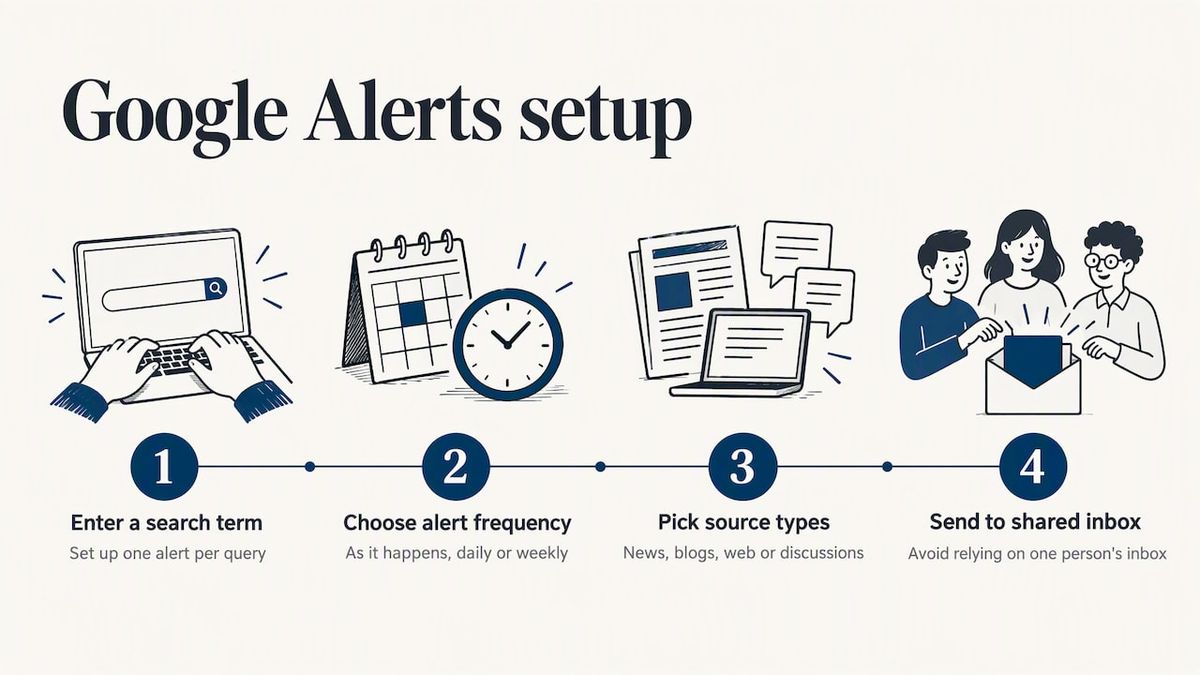
Google Alerts is free and takes a few minutes to set up. As one ecommerce guide explains, you enter a search term, choose how often you want alerts (as it happens, daily or weekly) and pick the source types, such as news, blogs, web or discussions. Set up one alert per query and send them to a shared inbox, not a single person's, so nothing stops when someone goes on leave.
Its limits are real. It misses much of social media, closed communities and many review sites, and it can lag. Treat it as a safety net.
Manual checks that still work
- Search your brand name on Google with the "News" tab and a past-week filter.
- Check the native search on LinkedIn, Facebook, Instagram, X and Reddit for your name.
- Read new reviews on Google Business Profile and any industry-specific review site your customers use.
- Look at referral traffic in your analytics for sites you did not know about.
The whole routine takes about 20 minutes a week for a small business. Put it in the calendar as a recurring task, not a good intention.
When to move to a paid monitoring platform
Free methods break when you need speed, social coverage or measurement. Dedicated platforms let you build Boolean queries to track brands, competitors and industry topics, and they send real-time email or app alerts, sentiment analysis and metrics such as reach and share of voice, as Mention describes on its monitoring page. Some tools in this category advertise coverage of over a billion sources, which is far beyond what manual searching can reach.
Consider paying when:
- You get more than a few mentions a day and cannot read them all.
- Social conversation is where your customers talk about you.
- You run a PR or marketing team that must report on coverage to executives or clients.
- A reputation issue would be costly, so you want alerts within minutes.
If you are comparing options, a directory of media monitoring software for Australia shows how these tools collect mentions across news, social media, blogs, TV and radio. Compare them on four criteria: coverage of Australian sources, how quickly alerts arrive, sentiment accuracy and whether you can export reports. Take free trials and test them with your own brand name, because a tool that looks excellent in a demo can miss your local press.
Set up a monitoring routine that gets used
A tool is only as good as the habit around it. This is the routine we would suggest for a small team.
- Pick an owner. One person is responsible, with a named backup.
- Write your query list as above and store it in a shared document.
- Create alerts in your chosen tool or Google Alerts, and route them to a shared inbox or channel.
- Triage daily for five minutes. Sort each mention into respond, record or ignore.
- Review weekly. Note the volume, the main themes and any mention that changed your plans.
- Review monthly. Prune queries that bring only noise and add new ones for launches or campaigns.
Treat monitoring as a continuous feedback loop that informs wider business strategy, not as something you set up once and forget. Industry guidance also notes that real-time monitoring helps organizations spot negative sentiment early, which can stop a small issue from becoming a reputational crisis.
What to do with what you find
- Positive press with no link: Email the author, thank them and politely ask whether a link to your site is possible.
- A factual error: Contact the publisher with the correct fact and a source. Keep the tone helpful.
- A complaint: Reply publicly with an offer to continue in private, then fix the root cause.
- A pattern: If the same question appears five times, it belongs on your website or in your next announcement.
Privacy: what Australian businesses should watch
Monitoring involves reading what people say online, so privacy law matters. This is general information, not legal advice. If you handle sensitive data or plan systematic collection, speak to a privacy lawyer.
Two practical points from Australian sources:
- Seeing a mention is not the same as collecting it. Guidance from the Office of the Victorian Information Commissioner deals with social media and the workplace. It suggests privacy law is unlikely to stand in the way of simply viewing public material, while collecting personal information from an employee's social media account needs a legitimate purpose. That guidance is from Victoria's public sector regulator, so check which rules apply to your organization.
- Be careful with tools that scrape personal details. One Australian agency guide says that citation and brand-mention tracking can touch the Privacy Act, and recommends avoiding the scraping of personally identifiable information from forums or reviews and sharing only anonymized or aggregated brand-level data with third-party tools. Read it as practitioner advice, and confirm against the Office of the Australian Information Commissioner's own guidance.
In practice: track brand-level queries, do not build profiles of individual customers, and do not use what you find in monitoring for decisions about staff without a clear, lawful purpose.
Mentions that matter versus mentions that merely exist
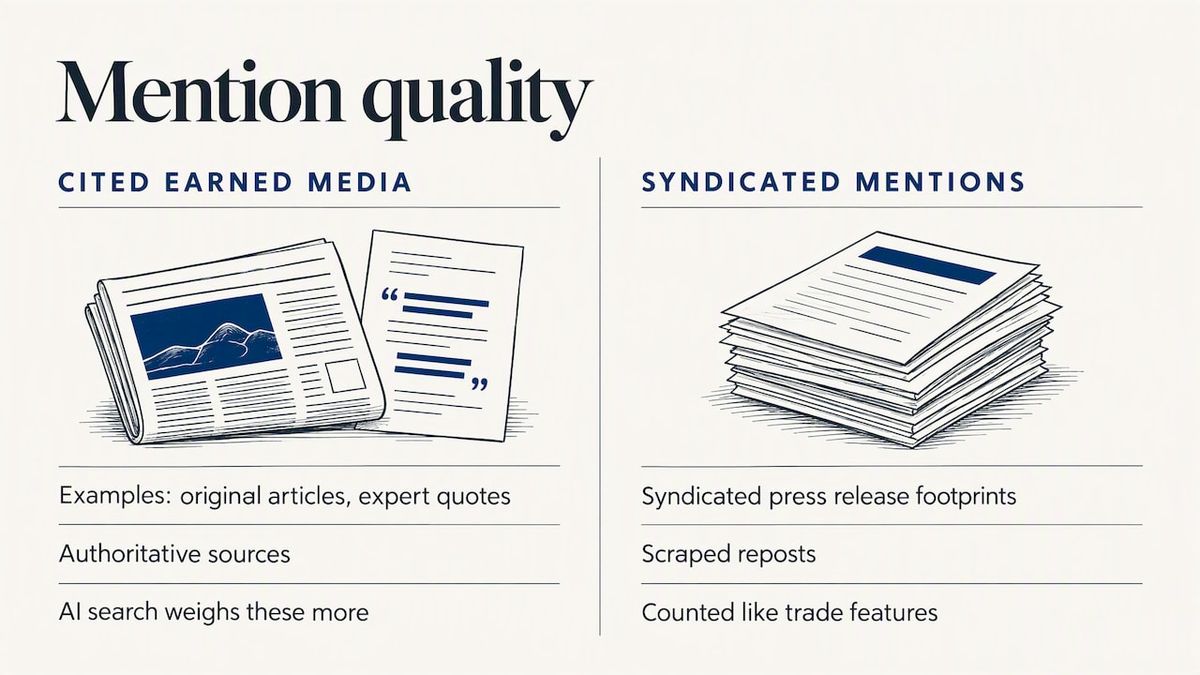
Volume is a weak measure. A crawler counts a scraped repost and a feature in a respected trade publication the same way. Practitioners point out that AI-powered search now weighs cited earned media, such as original articles, expert quotes and authoritative sources, more heavily than syndicated press release footprints. So look for citation opportunities, not just totals.
The same source also notes that what search engines and AI models say about a brand is increasingly tied to how consistent your facts are across the web. Add this to your monthly review: search your company and check that your description, location, founding details and leadership names match on every page you control or can influence.
Are press releases worth it?
Yes, for the right kind of news, and with realistic expectations. A press release is a tool for publishing a fact, not a guarantee of coverage.
What a release can and can't do
Industry experts, including those cited by CARMA, flag a common misconception: issuing a release is not the same as securing media coverage. Wire distribution is useful for creating a dated, public record of material facts, such as funding or regulatory changes. The most effective route to genuine, authority-building mentions remains personalized pitching to journalists who cover your beat.
On SEO, be sceptical of anyone promising rankings from syndication alone. The same On Pattison article warns against relying on low-quality syndicated distribution for SEO, but also says that when releases carry actual, up-to-date news they can still contribute to visibility.
What makes a release worth publishing
One SEO practitioner who changed his mind about releases lists the kinds of news that qualify: a hire, an acquisition, a funding round, a genuinely new product or a piece of original data. He also stresses that a named person should say something in the release, because attribution makes a sentence quotable.
A quick test before you pay for any distribution:
- Is there a new fact someone outside your company would care about?
- Does a named person stand behind a quotable statement?
- Can you state who it affects, where and when in the first two sentences?
- Would you be comfortable with it appearing as the permanent record of this event?
If you answer no to the first question, save your money and publish a blog post instead.
How releases connect to monitoring
Releases and monitoring work as a pair. The release is the action, and monitoring is how you find out what happened next. Before you publish, add the headline, product name and spokesperson to your alerts. In the week after, watch for pickups, reposts, journalist enquiries and social shares. Record which ones came from the release and which came from your own pitching. After three or four releases, you will know what your news is worth.
Perspective: how we think about mentions and releases
We run a press release distribution platform, so we see the same pattern often. Businesses publish a release and then look for results in the wrong places, or they never look at all. A release is a public, dated record of something you did. It is the start of a trail, and monitoring is how you follow it.
We also think releases should be held to a standard. That is why our submissions go through editorial review, with instant posting and a 24 to 48 hour review option, so what appears under your name is accurate and credible. Our releases are written for SEO so they stay discoverable over time, and the page remains available for the journalists, customers and AI tools that may look for your facts months later.
Our advice is simple. Publish when you have news. Name a person. Make the facts clear and consistent with everything else you publish. Then watch what comes back, and use it to decide what to announce next. Distribution does not replace relationships with journalists. It gives those relationships something concrete to refer to.
— Matthew
Publishing your news on News Today
If you have news that passes the test above, you can submit your press release and have it reviewed and published on News Today. A single release costs $39 on a one-off basis, and you can see details on the pricing page, including custom and enterprise solutions for teams with higher volumes. To see how others present their news, browse recent releases from Australian businesses and our editorial standards.
Once your release is live, add its headline to your alerts and track what follows.
A simple 30-day plan
| Week | Action |
|---|---|
| 1 | Write your query list, set up free alerts, name an owner |
| 2 | Run manual checks on social and review sites, note a baseline of weekly mentions |
| 3 | Trial a paid platform with your real queries, and check Australian coverage |
| 4 | Review the noise, prune queries, decide whether the paid tool earns its place |
At the end of the month, you will know your usual volume, your main sources and the topics people connect with your name. That baseline is what lets you judge a campaign or a release honestly.
FAQ
How can I monitor brand mentions for free?
Set up Google Alerts for your brand name, variations and key products, and choose daily or weekly digests. Add a weekly manual search of social platforms and review sites. This covers news and web mentions reasonably well, though it misses much social conversation.
What does "brand mention" mean?
It is any reference to your company, product or key people in online media, social posts, forums, blogs or reviews. A mention can be linked or unlinked, and positive, neutral or negative.
Is it legal to monitor brand mentions in Australia?
Monitoring public, brand-level mentions is common practice. The risk comes from collecting and acting on personal information, for example by scraping individuals' details or using findings in staff decisions. Keep queries brand-focused, avoid profiling individuals, and ask a privacy lawyer if your plans go further.
Are press releases worth it?
They are worth it when they announce real news, include a named spokesperson and state clear facts. They are a poor investment as a shortcut to rankings or coverage. Pair them with direct pitching and monitor the results.
Sources
- Semrush: What is Brand Monitoring and how does it work?
- Shift4Shop: How to Use Google Alerts to Monitor Your Brand Mentions
- Mention: Media Monitoring Tool
- SourceForge: Best Media Monitoring Software in Australia
- OVIC: Social media, privacy and the workplace
- Arfadia: Australian Privacy Act, a guide for SEO/GEO buyers
- On Pattison: Is Press Release Distribution Still Worth It?
- CARMA: Do press releases matter anymore?
- Jeremy Rivera SEO: I Was Wrong About Press Releases