
An app launch press release is an official announcement that tells journalists what has launched, who it is for and why it matters now. It works when it gives a reporter a story, not just a download link. This guide covers what to put in it, how to format it, how to find an angle Australian media will care about, and how to get it in front of the right people.
TL;DR
- A new app is rarely news on its own. Lead with the problem it solves, a local angle, real data or a first of its kind.
- Use a fixed structure: headline, dateline, short lead, audience and problem, key benefits, quote, availability and pricing, boilerplate, named media contact.
- Get internal sign-off, line up a spokesperson and prepare assets (screenshots, logo, store links) before you send.
- Send to relevant outlets, by email, ideally in the morning, and back it up with social posts and your own site.
- The same format also works for related announcements such as a store, office or location opening, with a different news hook.
Table of Contents
- What an app launch press release is, and when to issue it
- Find the news angle first
- What to include in an app launch release
- How to write and format it, section by section
- A template you can adapt
- Prepare before you send
- Timing and distribution
- Our perspective
- Publishing your release with News Today
- Grand opening, new store and new office releases
- Common mistakes to avoid
- FAQ
- Sources
What an app launch press release is, and when to issue it
MobiLoud describes the release as an official announcement explaining what has launched, who it is for and why it matters now. Three words in that definition do the work: launched, for whom and now. If you cannot answer all three in one sentence, the release is not ready.
The usual moments to issue one:
- Public launch. The app is live on the App Store, Google Play or both, and anyone can download it.
- Major update. A version that changes what the app does for people, such as a new feature set or a new market.
- Milestone. A user count, a partnership, a funding round or an award, where the app is the context rather than the news.
- Pre-launch with a firm date. Only when you can honestly say what people can do on that date, and only if the details will not change.
Do not send a release for a beta that may slip, or for a launch where the store listing is not yet approved. A release with a wrong date or a dead link costs you the trust of the journalists you most want to keep.
Find the news angle first
This is where most app releases fail. Australian agency Three Sides makes the point plainly: a new app by itself may not be news. What can make it news is being first or one of a kind, using new technology, bringing new statistics, having a local angle or affecting how people spend their money.
Adhesive, a communications agency working in Australia and New Zealand, adds that a launch is more newsworthy when it connects to a broader trend or tension, has local relevance, offers substance such as data or a clear point of view, and is timely. In practice that means a journalist at a regional paper, a trade title or a consumer technology desk asks: why would my readers care this week?
Before drafting, test your launch against this list:
| Angle | Question to ask | Example of a usable hook |
|---|---|---|
| Problem | What frustration does it remove, and for whom? | Tradies chasing unpaid invoices on a Friday night |
| Local | Is there an Australian town, industry or customer behind it? | Built in Hobart, first used by 40 local cafes |
| Data | Do you have numbers from testing, a pilot or a survey? | A pilot cut booking no-shows in a measured, stated way |
| Trend | Does it connect to something readers already talk about? | Cost-of-living pressure, AI tools, cyber safety |
| First | Is it genuinely the first or only one of its kind? | Only if you can prove it |
| People | Who benefits, and will they speak on the record? | A customer or pilot partner willing to be quoted |
Pick one lead angle. Put the others lower in the release. If none of the rows gives you a real answer, spend a week finding one (a pilot result, a customer story, a small survey) before you write a word.
What to include in an app launch release
MobiLoud's checklist is a good baseline: the app name and launch in the headline; a lead covering who, what, when, where and why; the audience and the problem; the main capabilities tied to benefits; a useful quote; availability, links and any region, device, account or pricing limits; a factual company boilerplate; and a named media contact with an email and supporting images or a press-kit link. Shopify Australia lists much the same for product launches: a compelling headline, concrete specifications, visuals, a company refresher, useful links, availability and pricing, and contact information.
Two details trip people up:
- Limits. If the app is iPhone only, needs an account, or is not yet available outside Australia, say so in the body. A journalist who downloads it and cannot get in will not write about it.
- Pricing. State whether it is free, freemium or paid, and what the paid tier costs, in Australian dollars if you are targeting local media.
How to write and format it, section by section
The job of the release is to make the launch accurate and easy to cover. Concise, specific customer value beats a long feature inventory. Keep the whole piece to roughly 300 to 500 words, one page.
Headline
A clear, specific formula works: [Company] launches [App] to help [audience] [outcome]. Keep it under about 15 words, name the app, and avoid superlatives you cannot prove.
Example: "Perth startup Tidyline launches app to help sole traders send invoices in under a minute" (a fictional example for illustration).
Subheading and dateline
An optional subheading adds one supporting fact, such as availability or a pilot result. The dateline gives city and date at the start of the first paragraph. US releases follow a pattern like CITY, State, Month DD, YYYY. For an Australian audience write it the local way: PERTH, WA, 12 May 2026.
Lead paragraph
Two sentences: who launched what, for whom, when and where to get it, and why it matters. If a reader stops here, they should still have the story.
Problem and audience
One short paragraph on the problem in the language your audience would use. Add a number if you have a trustworthy one, and name its source.
Key benefits
Three or four benefits, each tied to an outcome. "Scan a receipt and the expense is categorised" is a benefit. "Powered by advanced machine learning" is a feature that tells a reader nothing. Technical detail belongs in the press kit.
Quote
A founder or customer quote should interpret the launch, not repeat it. "We are thrilled to announce" adds nothing. A sentence on why you built it, or what a pilot customer saw, gives a journalist something to run. Only quote people who have approved their words.
Availability and pricing
Platforms, store links, regions, languages, minimum operating system, price. Plain statements, no hype.
Boilerplate and media contact
The boilerplate is a short, factual paragraph about your company: what it does, where it is based, when it started. Then a named person with an email address and a phone number, reachable that day. Finish with ### on its own line, the traditional end mark. Link to a folder with a logo, screenshots, a short screen recording and a founder photo that anyone can open without logging in.
A template you can adapt
[Headline: Company launches App to help audience outcome]
[Subheading: one supporting fact]
[CITY, STATE, DD Month YYYY] [Company] today launched [App], a [type of app] that helps [audience] [do what]. It is available now on [platforms] for [price].
[One paragraph: the problem, with one verified fact or figure.]
[App] lets users:
- [Benefit one]
- [Benefit two]
- [Benefit three]
"[Quote that explains why it was built or what early users found]," said [Name, title].
[Availability: platforms, regions, limits, price, download link.]
About [Company] [Two or three factual sentences.]
Media contact: [Name, email, phone]. Assets: [link]
Prepare before you send
The Fisheries Research and Development Corporation's guidance on media releases tells writers to get the proper authority and the right internal and external approvals before sending. For an app launch that usually means your founder, any named partner or customer, and anyone who has to approve claims about security, privacy or health.
A short pre-send checklist:
- Every figure, name, title and date checked against a source.
- Store links tested on both iOS and Android, on mobile data, not only office wifi.
- Quoted people have read and approved their lines.
- A spokesperson is free to talk. Communications firm BBS notes that spokespeople should be available when the release goes out, because journalists work to deadlines.
- Press kit folder is public and the files are named clearly.
- Privacy policy and terms are live, since reporters often check them.
Timing and distribution
Timing an announcement alongside other important news can make it more newsworthy and improve the chances of coverage. Look for a hook: a data breach in the news for a security app, a tax deadline for a finance app, a school holiday for a family app. If your launch is also meant to spark conversation on social platforms, it helps to know the best time to post on TikTok so your supporting posts land when your audience is online.
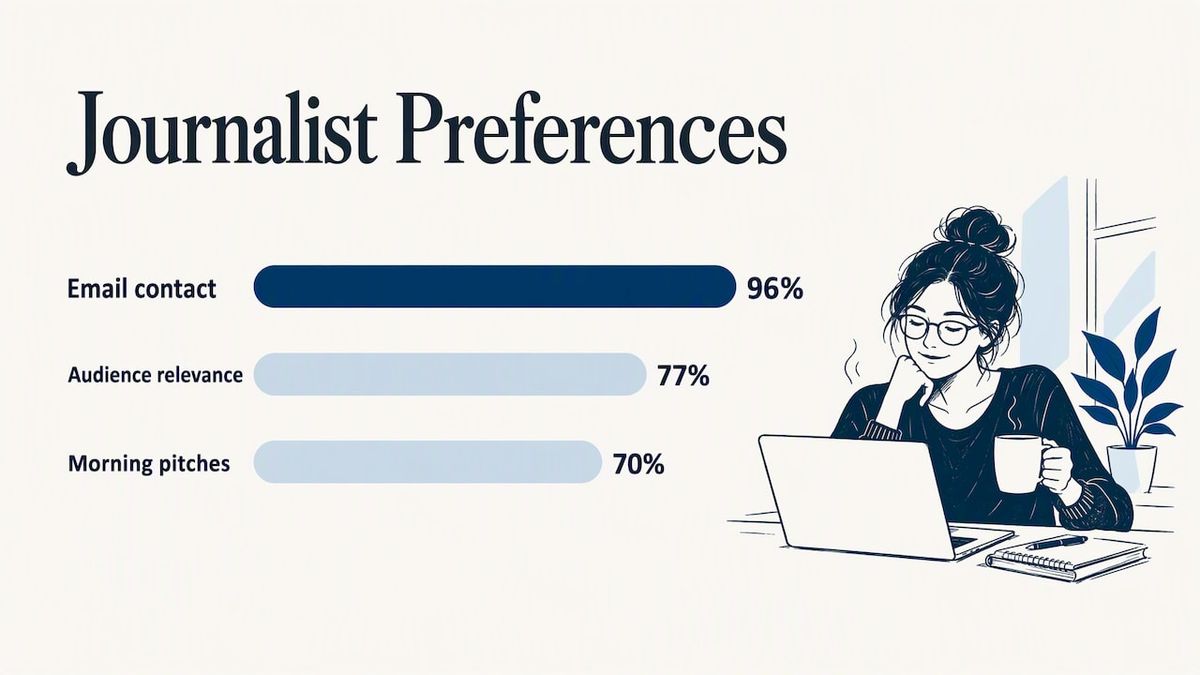
Medianet figures quoted by Glance report that 77% of journalists value content relevant to their audience, 70% prefer morning pitches and 96% name email as a preferred contact method. Practical takeaways: send early in the day, email rather than call cold, and tailor your note to each outlet.
A release is not advertising. Distribution cannot manufacture interest, and Shopify Australia advises focusing on news value and sending to relevant outlets, supported by wider channels such as social media. A sensible mix:
- Direct emails to a short list of journalists who have covered similar apps. Put the key facts in the body, not an attachment.
- A published release on a distribution platform so the story has a permanent, searchable home.
- Your own site, with the release, press kit and a short FAQ.
- Social posts from the company and founders, linking to the release.
- Customers and partners, who can share the news with their own audiences.
Our perspective
We see a lot of announcements, and the pattern is consistent. The ones that read well are about a person with a problem, not about a product with features. Launch day feels huge inside a company, but a journalist sees dozens of "we are excited to announce" emails a day.
Our advice is to write the release you would want to receive. Say what the app does in the first sentence. Give one concrete result or one real customer. Put the download link where it cannot be missed. Then publish it somewhere permanent, because a release with a clear headline and useful detail keeps being found long after launch week. A press release is a record that journalists, customers, investors and search engines can all return to, so accuracy matters more than adjectives.
We also think smaller organisations should not be put off. A startup or nonprofit with one honest local story often has a better angle than a big brand with a generic one.
— Matthew
Publishing your release with News Today
If you want a permanent home for your announcement, you can submit your press release to News Today. The platform supports media-rich submissions, category targeting and SEO-optimised syndication, with review that takes from instant publication to 24 to 48 hours depending on the route. A single release costs $39, and agencies or frequent publishers can ask about custom and enterprise solutions on the same page. Our editorial standards page explains how we review submissions for credibility and accuracy. You can also see how other businesses write theirs, such as this Petaflo announcement for a software service, or Rennen Motorsport's launch of a new offering.
Grand opening, new store and new office releases
Many people searching for app launch releases also need a release for a store, office or location opening. The skeleton is the same: a headline that names the business and the place, a dateline, a lead with who, what, when and where, a quote, practical details and a boilerplate. What changes is the purpose and the hook.
An app launch announces something people can use anywhere, so the hook is the problem it solves. A grand opening announces a place people have to visit, so the release is also a practical invitation. It should state:
- The street address, suburb and a map link.
- Opening date and hours, and any opening-day event, offer or guest.
- What is new for the neighbourhood: jobs created, a first-in-the-area product or service, a local owner or supplier.
- Parking, public transport and accessibility details.
- A contact for photo opportunities on the day.
For a new office or location, the local angle is the story: hiring numbers, the reason for choosing that city, the industry it serves. If you are a mobile business opening a new store, send local media, the council or chamber of commerce newsletter and community pages, not only national outlets. Local releases also tend to suit the case studies on our own platform, such as a local business meet-up announcement or a sponsorship of a local league.
Common mistakes to avoid
- Launching without a story. "Our app is now available" is not a reason to cover it.
- Burying the link. The store link belongs in the lead and again near the end.
- Jargon and superlatives. "Revolutionary", "game-changing" and "cutting-edge" tell a reporter you have nothing specific to say.
- Unverified claims. Rankings, user counts and security statements need evidence.
- No contact. A generic info@ address and no phone number will lose you a story on deadline.
- Heavy attachments. Use a link to a public folder instead.
- Sending once and stopping. One short, polite follow-up is fine. Then move on.
FAQ
How long should an app launch press release be?
Aim for 300 to 500 words, which fits on one page. Put the essential facts in the first two paragraphs and leave extra detail to the press kit and your website.
Do I need a press release if my app is small?
Yes, if you have a real story. A small app with a local angle, a clear user problem or a pilot result can earn coverage in niche and regional outlets. A release also gives you a permanent, shareable record of the launch.
When should I send it?
Send it when the app is live and the store links work, ideally in the morning and on a weekday, since many journalists prefer morning pitches. Avoid days dominated by major news that could crowd out your story.
What should I include with the release?
Provide a logo, three or four screenshots, a short demo video, a founder photo and the store links, all in a public folder. Add a named contact with email and phone, so a journalist can reach you quickly.
Does a grand opening release follow the same format?
Mostly. It uses the same headline, lead, quote and boilerplate structure, but replaces the app details with address, opening hours, opening-day events and what the new location brings to the area.
Sources
- How to Write a Press Release for Your App Launch, MobiLoud
- Making your news NEWSworthy, Three Sides
- What makes a story newsworthy in the Australian and New Zealand market, Adhesive
- How to Write a Product Launch Press Release, Shopify Australia
- Guide to writing a media release, FRDC
- Timing is everything, BBS Communications
- How Do I Get Press Coverage for My New App?, Glance
- Best time to post on TikTok