
An education press release is a short, factual announcement from a school, university, training provider, peak body or education nonprofit, written so a journalist can see the public story in the first two sentences. It works when it leads with what changes for students, families, employers or the community, not with the institution's name. This guide covers which news is worth announcing, how to structure the release, what to include, how university releases differ, when to send, and how to tell whether it worked.
TL;DR
- Lead with the public benefit (access, jobs, research findings, funding), then name the course, program or institution.
- Follow the standard shape: headline, a lead covering who, what, where, when, why and how, body in descending importance, call to action, media contact. Aim for one page.
- Include named, titled people who are available for interviews, approved quotes, and captioned, credited images.
- University and school releases usually pass through a central communications team, so check approvals before anything goes out.
- Send early, follow up briefly, and review coverage afterward to improve the next release.
Table of Contents
- What counts as an education press release
- Finding the angle journalists want
- How to structure the release
- What to include before you hit send
- How a university press release differs
- Perspective: what we see in education announcements
- Distributing an education press release in Australia
- When to send and how to follow up
- Checking whether it worked
- FAQ
- Sources
What counts as an education press release
A media release is designed to attract media attention and coverage, so it has to be interesting and relevant to the outlets receiving it. That is the definition used in a national Australian guide to writing a media release. The same guide shows how an education-adjacent topic earns attention: a teachers' resource kit was framed around educating schoolchildren and the economic value of an industry, not around the kit itself.
That is the test for every education announcement. Ask: who outside our own community cares, and why today?
The range of news is wider than most education teams assume. A look at Curtin University's 2026 media-release index shows scholarships, student-support research, awards, research discoveries, preschool findings, major research funding and education programs all sitting side by side. The beats differ, but each item has a clear public-facing angle.
Announcements that tend to earn coverage
- New courses and degrees. Strongest when tied to a workforce need.
- Scholarships and access programs. Who can apply, how many places, what it removes as a barrier.
- Research results. Findings about learning, teaching, early childhood or student wellbeing.
- Funding and partnerships. Grants, industry partnerships, new facilities.
- Awards and appointments. Teaching awards, new principals or deans, honours for staff and students.
- Community programs. Tutoring, literacy drives, adult learning, nonprofit education initiatives.
- Responses to sector issues. Peak bodies and unions regularly comment on policy and pay, which is why they dominate the search results for this topic.
Announcements that rarely do
Open days, internal restructures, routine timetable changes and generic "we are proud" milestones usually belong on your own website, newsletter or social channels. A media release is one tactic among several. ANU's media guidance lists alternatives such as a website story, an opinion piece, direct pitching to selected journalists and social-media strategies. Choose the format that fits the story, not the one you always use.
Finding the angle journalists want
The most common mistake is announcing a thing instead of a change. "The university launches three new degrees" is a notice. A more useful frame is the one ECU used for new Creative Humanities degrees: it opens with the practical public value, then explains the skills and industry-partnership angle, and only then lists the courses and when they start.
Use this quick filter before you write:
- Who benefits? Students, parents, teachers, employers, regional communities.
- What is new? A first, a change, a number, a result.
- Why now? A school term, a policy debate, an enrolment period, an anniversary, a report.
- What is the proof? A figure, a study, a named person with authority.
- Who is the outlet? A local paper wants the local student. A trade title wants the sector implication. A national outlet wants the broader trend.
If you can answer only the first question, the story is probably not ready. For a deeper look at tying a topic to a wider conversation, the principles in writing engaging content apply directly: know the reader, give them a reason to continue and keep the substance concrete.
Sometimes a broader education trend gives you the hook. Coverage of online learning in UK schools and sixth forms is an example of how a sector shift can frame a local announcement, if you can show how your own program responds to it with real figures.
How to structure the release
The structure is the same whether you are a primary school or a research university. The national guide above recommends a clear headline, then a lead answering who, what, where, when, why and how. After that the story develops in descending importance, acknowledgments follow if needed, and the release finishes with the action or next step and a media contact. It also advises third person, short accessible sentences, no jargon and a length of about one page.
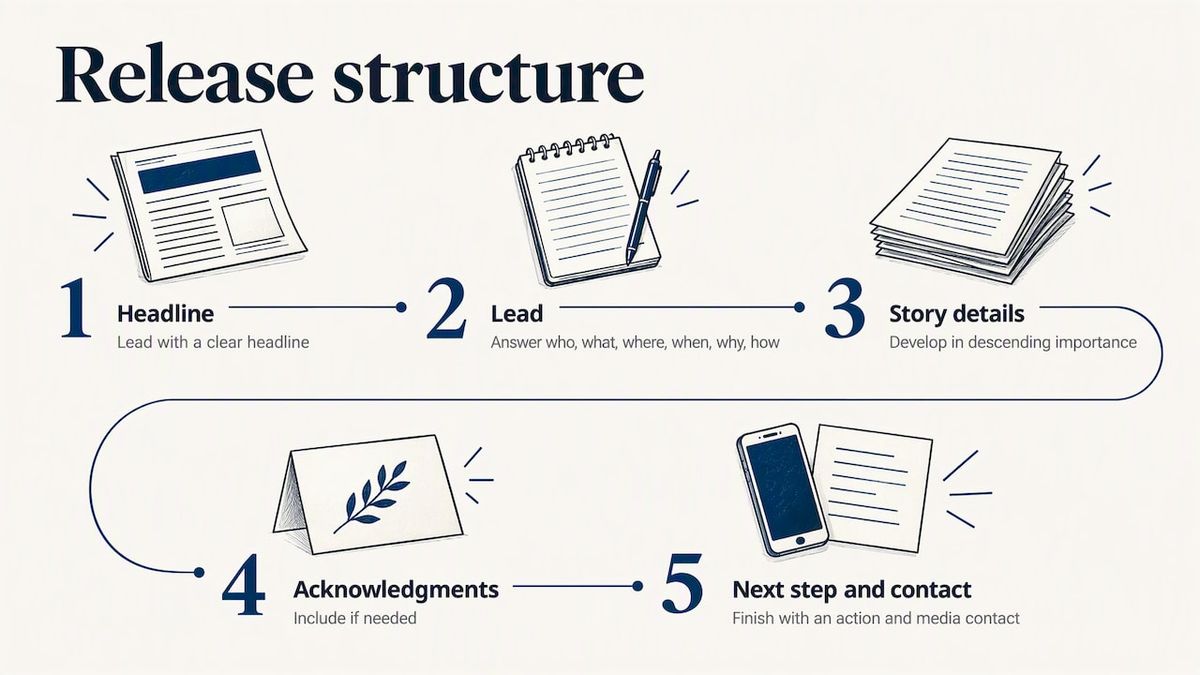
Headline
One line, specific, with a verb. Put the news first and the institution second.
| Weak | Stronger |
|---|---|
| Greenfield College Announces New Program | Free trade scholarships open 40 places for regional students |
| University Research Update | Study finds short daily reading sessions lift Year 3 literacy |
| Annual Awards Night Held | Local teacher named state's best for rural science program |
The examples above are illustrative formats, not real announcements. Replace the figures with your own verified facts.
The lead
Your first paragraph carries the whole story. A reader who stops after two sentences should know who is doing what, where, when and why it matters. Dates in the lead should be exact ("from Term 1") so nobody has to phone you to clarify.
The body
Order paragraphs by importance, not chronology. Typical sequence for a program announcement:
- The change and its public value.
- The evidence: enrolment numbers, funding amount, research method, employer demand.
- A quote that adds opinion or meaning, never one that repeats the facts.
- Practical details: eligibility, cost, start date, how to apply.
- Background about the institution, in two sentences at most.
The ending
Finish with what you want the reader to do next (apply, attend, read the report) and a media contact. A boilerplate paragraph about the organization can follow, but keep it short.
What to include before you hit send
A release that makes a journalist chase you for basics loses to one that doesn't. The same guide's checklist translates well to education announcements:
- Full names and titles for every person mentioned.
- Attributed quotes, approved by the person quoted.
- Appropriate approvals from your institution, funder or partner.
- A reachable media contact with a mobile number that will be answered.
- Available spokespeople. The guide says quoted people should be available for interviews when the release goes out. If your principal is travelling, say so up front or choose someone else.
- Acknowledgments for partners and funders where needed.
- Images or sound bites: high-resolution, captioned and with the photographer credited.
In education, add two more checks. First, student privacy and consent: get written permission from parents or guardians before naming or photographing minors, and follow your school or institution's own policy. Second, claims you can support: any ranking, graduate outcome or research result should be traceable to a document you can hand a journalist on request.
How a university press release differs
The core craft is identical, but the context around university releases changes three things.
Audience
Universities write for several audiences at once: general news outlets, specialist trade and science media, funders and prospective students. A research finding may suit a national outlet in plain language and a specialist journalist with methodological detail. Many universities therefore tailor the pitch rather than sending one text to everyone.
Angle
University news leans toward research, expert commentary and funding. Education providers at school or vocational level lean toward community impact, local students and outcomes. If you run a university, ask whether a staff expert commenting on a current issue is a better story than the institution announcing itself.
Process
This is where most of the difference lies. Australian universities typically route media through a central team:
- ANU says staff should contact its Communications and Engagement team early, before writing, so the most newsworthy aspects can be identified and a tailored strategy developed. That team approves and distributes all its media releases and monitors media performance.
- Monash's media procedure has its media team develop releases with academics and faculties, pitch stories, manage interviews and report on media outcomes and trends. Official releases go out only through that team, and external agencies need prior approval before pitching or distributing for the university.
- CQUniversity's procedure assigns writing, distribution and journalist liaison to Corporate Communications, and asks staff who spot a media risk or opportunity to contact that office promptly.
- Excelsia's communications framework places media releases with its Marketing Department and requires a professional journalistic style, coordinated timing and authorised content.
The practical lesson: if you work inside a university, talk to your communications office before you write a word. If you are an agency or an affiliated body, confirm in writing who is authorised to issue the release. The same applies to many schools and education departments, which have their own media policies.
Central media pages also show what journalists need from you. The University of Newcastle's media centre gives a central email and phone for interviews, comment, research experts and campus photography or filming. The University of Sydney's media contacts page lists a central office, after-hours escalation and named contacts. Copy that clarity: one obvious route to a human who can say yes quickly.
Perspective: what we see in education announcements
We run a press release service, so we read a lot of announcements, and the pattern is consistent: the releases that get picked up say what changes for a person, not what an institution has done. A school that writes "our new reading program" gets ignored. A school that writes what the program means for children who are behind, with a teacher quoted and a figure behind the claim, gives an editor something to run.
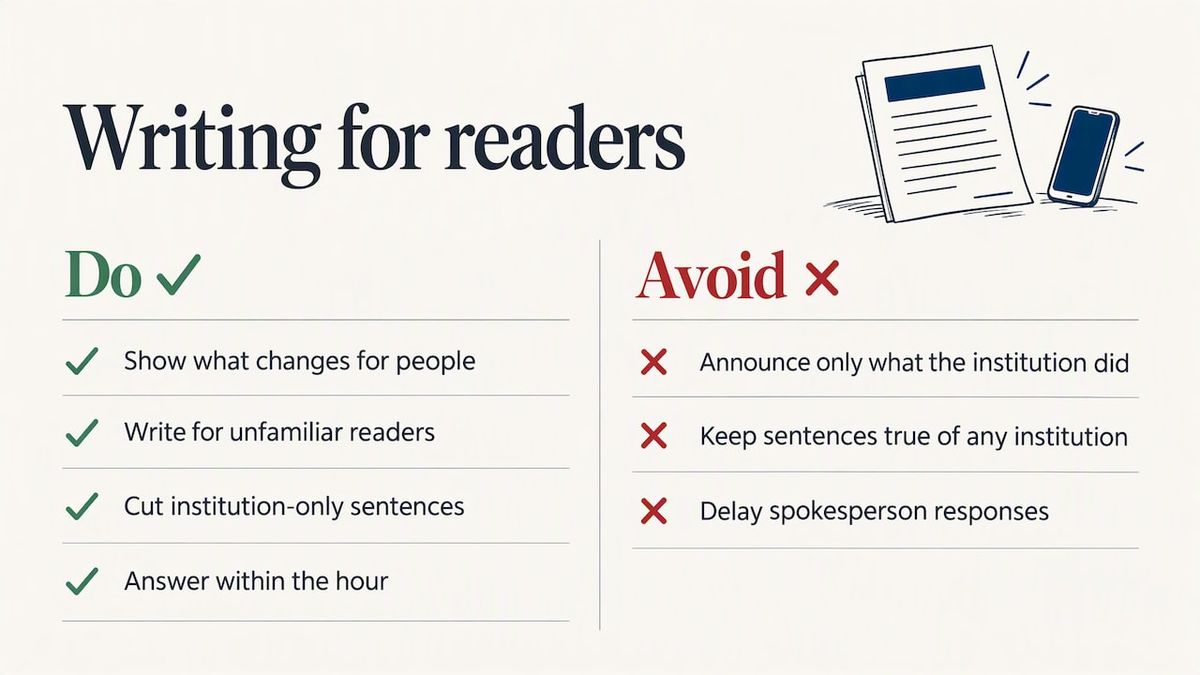
Our advice to education teams is simple. Write the headline as if the reader has never heard of you. Cut every sentence that would still be true if you replaced your name with another institution's. And treat the media contact as part of the story: a spokesperson who answers within the hour will turn one release into a second story.
We also review every submission before it goes live, with a quick turnaround, because accuracy matters more in education than almost anywhere. Parents, students and funders act on what they read. If something needs correcting after it goes out, we have a guide to fixing an error after publishing.
— Matthew
Distributing an education press release in Australia
Writing is half the job. The other half is putting the release in front of the right people. Large universities such as Monash distribute through a mix of newswire and research-alert platforms alongside direct pitching. Smaller providers, nonprofits and startups rarely have that infrastructure, so it helps to think in layers:
- Direct pitch. For a strong local story, email one journalist with two lines and the release below. Pick someone who has covered education recently.
- Distribution service. A release service puts your announcement onto a searchable page and delivers it to media lists, giving it a durable, indexable home.
- Your own channels. Publish the same facts on your website newsroom, newsletter and social accounts, linking to the release.
- Partners. Funders, industry partners and community groups often share announcements that name them.
Our own guide to sending a media release in Australia walks through the practical steps, including targeting and follow-up.
Publish with News Today
If you want a fast, affordable way to put an education announcement online and in front of journalists, you can submit your release and it goes through our editorial review before publication. A single release is $39 one-off, as listed on our pricing page, and the same page covers custom and enterprise solutions for agencies and organizations with a steady stream of announcements. You can read how our editorial standards work before you submit.
When to send and how to follow up
Timing in education is driven by the calendar: enrolment periods, school terms, exam seasons, awards and funding rounds. Work back from the date the audience needs to act, then give journalists lead time.
Inside institutions, lead time is also an approval issue. Excelsia's framework asks staff to notify Marketing as soon as possible about expected media visits or opportunities, preferably at least a week ahead, and to flag contentious issues promptly. Treat that as good practice anywhere: timing, authorisation and media readiness are controls you set up before sending, not after.
A simple routine:
- Two weeks out: confirm the angle, spokesperson and approvals.
- One week out: finalize quotes, images and the release text.
- Send day: publish the release and send individual pitches in the morning, so journalists can plan their day.
- Next day: one short follow-up to anyone who showed interest. Offer an interview, a photo or a data point, not a reminder that you wrote an email.
- After that: stop. A second follow-up with new information is fine. A third message with none is not.
Checking whether it worked
Monash reports on media outcomes and trends, and that habit is worth copying at any scale. After each release, collect:
- Pickups: which outlets ran the story, and whether they quoted your spokesperson.
- Reach and traffic: visits to the release page and to the linked program or application page.
- Actions: applications, enquiries, sign-ups or downloads that follow.
- Quality of coverage: did the headline carry your key message?
Compare releases over a term or a year to see which angles and send times perform best. Our guides on earned media metrics and monitoring brand mentions cover what to track and how to report it to a board or principal.
FAQ
What is the difference between an education press release and a news article?
A press release is written by the organization and supplies the facts, quotes and contact details; a news article is written by a journalist who may use only part of it. A good release is written so a journalist can lift it almost directly. It stays factual, in third person, and about one page.
Do I need a central media team to send a university press release?
In many Australian universities, yes: official releases are written, approved and distributed through a communications or media team, and outside agencies need approval. Check your institution's media policy before writing. If you are a smaller school, college or nonprofit, you decide your own process, but get approval from whoever is accountable for your public statements.
How long should an education press release be?
About one page, which is usually 300 to 500 words. Put the most important facts first and move background to the end, so editors can cut from the bottom without losing the story.
Can a school announce student achievements in a press release?
Yes, but get consent first. Obtain written permission from parents or guardians before naming or photographing students under 18, and follow your school's or education authority's media and privacy policy. When in doubt, quote a teacher or principal and describe the achievement without identifying the child.
Sources
- Guide to writing a media release, May 2024
- Media releases, Curtin University
- ECU's new Creative Humanities degrees
- Get media coverage, ANU
- Media and Social Media Procedure, Monash University
- Media Relations Procedure, CQUniversity
- Marketing and Communications Framework, Excelsia
- Media centre, University of Newcastle
- Media contacts, University of Sydney