
If a press release has gone out with a wrong figure, date, name or quote, do not try to quietly swap the file. Issue a new, complete release marked CORRECTION, name the original by headline and date, state exactly what was wrong, give the right information, and tell every journalist and platform that already has the first version. Most syndication channels will not let you edit what they have already sent, so the correction travels as its own release.
This guide walks through that process for Australian businesses, agencies and nonprofits. It covers the wording, the order of steps, what outlets will and will not do, when a mistake becomes a legal matter, and how to approve quotes so the problem does not come back.
TL;DR
- Publish a separate, standalone correction. Label it CORRECTION in the headline or subtitle, reference the original by headline and date, and say what changed.
- Do not expect outlets to replace the old file. Some have a published policy that the first version received is final, so the correction has to reach people on its own.
- Tell journalists directly and promptly, in plain terms, without blaming a vendor or softening the error.
- If the mistake could mislead customers about price, savings or product claims, treat it as a compliance matter under Australian Consumer Law, not just a PR problem.
- Prevent repeats: approve each quote word for word after the final edit, and keep a version log.
Table of Contents
- Why a correction beats a quiet fix
- How serious is the error?
- What a good correction contains
- What outlets will and will not do
- Step by step: issuing the correction
- When a mistake becomes a legal matter
- Quote approval: the cause of many corrections
- Perspective: why we ask for the final version once
- Getting the correction out on News Today
- Checklist before you hit send
- FAQ
- Sources
Why a correction beats a quiet fix
The instinct after spotting an error is to make it vanish. Resist it. Journalists who already hold the first version will not see a silent edit, and any who spot the discrepancy later will wonder what else you hid.
Commentary on how newsrooms handle mistakes makes the same point: transparency is the most effective response to an error, and a direct, prompt correction protects trust, whereas softening it tends to make the mistake look bigger and more deliberate. The same source notes that corrections should be labeled as corrections, with no euphemisms such as “clarification” or “fix”.
There is also a professional reason. The MEAA Code of Ethics asks Australian journalists to do their utmost to achieve fair correction of errors. If you treat reporters as partners in getting the facts right, they are far more likely to update a story they have already written than if they find the problem themselves.
How serious is the error?
Not every slip needs the same response. Sort the mistake before you decide how loudly to correct it.
| Severity | Examples | Response |
|---|---|---|
| Minor | Typo in a non-critical word, wrong job title spelling, broken link | Short correction release if the release is still being picked up; direct note to journalists who covered it |
| Material | Wrong date, venue, price, statistic, funding amount, product spec | Full correction release plus personal emails and calls to everyone who received the first version |
| Serious | Misattributed or invented quote, false claim about a product, a figure that could mislead buyers or investors | Correction release, direct outreach, written sign-off from leadership and legal advice before you publish |
A useful test: would a reader act differently if they knew the right fact? If yes, it is at least material. A wrong event date means people turn up on the wrong day. A wrong discount figure can mean customers pay more than they expected.
What a good correction contains
A correction is a short, calm, standalone document. Practitioners agree on a simple pattern, and a professional correction should identify the original by headline and date, state the error, give the correct information, and note that everything else is unchanged.
In practice, build it from these parts:
- A headline that carries the label. Start with CORRECTION, then the original headline or a close paraphrase. Someone scanning an inbox must know what this is before opening it.
- A first line that names the original. Give the original headline and the date it was issued.
- A plain statement of the error. Say what was wrong and what is right. Use the same numbers, names and format as the original so the two can be compared.
- The full corrected release. Repeat the entire announcement with the fix in place, so editors never have to stitch two documents together.
- A line confirming nothing else has changed. This stops readers doubting the rest.
- The same contact details as the original, so journalists reach the same person.
A worked example
Say a Perth software company announced a product launch for 14 November, but the launch is actually on 4 November. The correction might read:
CORRECTION: Example Software launches new scheduling tool on 4 November
This release corrects the announcement issued on 20 October, which gave the launch date as 14 November. The correct date is 4 November. All other details are unchanged.
[Full corrected release follows, with the date fixed throughout, including the quote and the boilerplate.]
Notice what is missing: no apology paragraph, no excuse, no mention of who made the mistake. A short, accountable note is enough. Defensive language or blaming a vendor draws attention to the error, not to the fix.
Check the whole document again
Errors cluster. If the date was wrong in the headline, check it in the body, the quote, the boilerplate, the image captions and any linked landing page. Fixing one instance and leaving another is how a second correction becomes necessary.
What outlets will and will not do
This is where most corrections go wrong. You cannot assume the original can be changed.
Some media outlets state their position openly. One Australian business-news publisher says on its FAQ page that an updated release will not be considered because the first version received is treated as final. Another technology outlet runs a comparable submission policy, and the research behind this article found that replacing a file is rarely supported by automated syndication networks. The same logic applies to email-based distribution tools. One distribution help page notes that a release can be edited only until shortly before sending and cannot be edited or retracted once it is sent.
That last point matters when you plan. If you are using a scheduled or held send, you have a short window to fix errors. After it closes, the correction is a new release.
So expect three outcomes:
- The outlet updates the live page. Best case. It usually happens only when you ask a named editor, politely and with the corrected text attached.
- The outlet publishes your correction as a separate item. Common. The old version stays up, but the record is clear.
- The outlet does nothing. It happens with automated feeds and rigid policies. Your own channels then carry the truth: your newsroom page, your website and your social accounts.
Before you send anything, check the outlet's submission rules. Some insist that releases go to one specific address, and sending to other addresses or individual editors can lead to rejection. Follow the rule first, then phone or email the editor you already know.
Step by step: issuing the correction
1. Confirm the facts
Get the right information in writing from the person responsible. Do not publish a second wrong version. If a quote is involved, the speaker must approve the corrected wording (more on this below).
2. Get sign-off
One person with authority approves the correction before it goes out. For serious errors, add legal review.
3. Fix your own house first
Correct the release on your website, your newsroom page and any social posts. If you cannot edit a post, add a visible note pointing to the correction.
4. Publish the correction release
Submit it through the same channel as the original, so it reaches the same audience. A widely shared piece of advice is to resubmit the full release to the distribution service so the many outlets that pick it up receive the right version. Use a fresh headline with CORRECTION in it so it does not look like a duplicate.
5. Tell journalists personally
Send a short note to everyone who covered the original or was on the list. Keep it brief: what was wrong, what is right, corrected release attached. Do not make a drama of it. If a reporter has already published, offer them the exact wording they need to update their story.
6. Follow up and keep a record
Check whether coverage was updated. Keep a log of what was changed, when, and who was told. If someone later disputes the facts, the log answers the question.
When a mistake becomes a legal matter
Most corrections are simply good manners. Some are more than that. If the error misleads customers about prices, savings, product features or services, Australian Consumer Law may apply, and the stakes rise.
The ACCC has secured court orders requiring businesses to publish corrective notices. In one case involving an outdoor store, the court found an advertisement misrepresented what customers would have paid and saved. The related judgment, ACCC v Clarion Marketing [2009] FCA 1441, recorded that the court could order corrective advertising under s 86C of the then Trade Practices Act. Those cases concern advertising, and the details differ from one matter to the next, so treat them as an illustration of why accuracy in public statements matters, not as a rule that every press release error triggers a court order.
Regulators also pursue disclosure problems. ASIC, for example, sued a major retailer over advertisements for interest-free purchases, alleging that disclaimers were hard to see or hear. That was an allegation in court documents when reported.
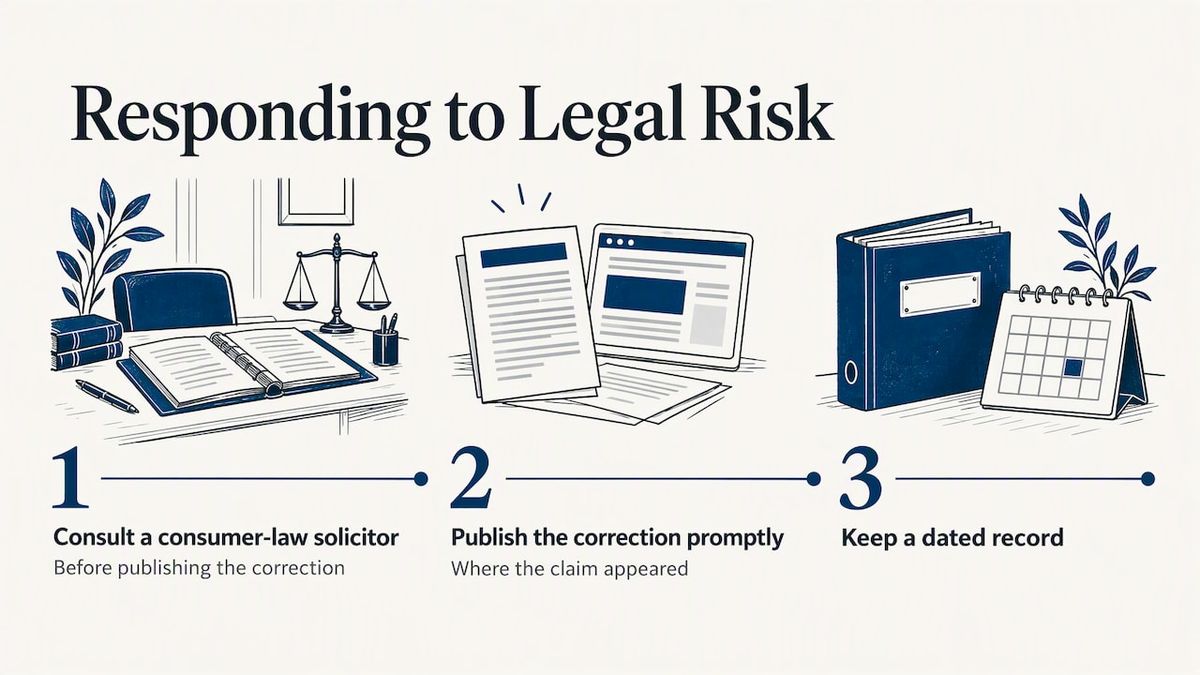
Practical advice: if your press release made a claim about price, savings, safety, health or finance and it was wrong, speak to a solicitor who handles consumer law before you publish the correction. Publish the correction in the same places the claim appeared, promptly, and keep the dated record.
Quote approval: the cause of many corrections
A surprising number of corrections trace back to a quote. A line was reworded after the speaker agreed to it, a title was out of date, or the speaker never saw the final version. This is also the other question people ask: who has to approve a quote, and when?
The answer is that the person quoted should approve the exact final wording before the release goes out, alongside sign-off from someone authorized to approve the release for the organization. Two things are often confused:
- Permission to be quoted: the general okay to be mentioned or to supply a comment.
- Approval of final wording: the speaker has seen the exact words, name and title as they will be published.
Practitioners point out that any change after approval, however small, technically invalidates the earlier agreement. A customer or partner effectively owns their portion of the release, so a stylistic tweak by an editor still needs re-approval.
A simple quote routine
- Draft the release, including quotes, and finish all edits.
- Send each speaker their quote only, exactly as it will appear, with name and title.
- Get written approval (an email reply is enough for most uses).
- If anything changes, even a comma, send it back.
- Before submitting, compare the final text with the approved text. Keep a log per quote and per version, as experienced practitioners do.
This takes minutes and removes the most awkward kind of correction, the one where you have to explain to a partner why their words were altered.
Perspective: why we ask for the final version once
We see press releases from businesses, agencies, startups and nonprofits, and the avoidable errors are rarely dramatic. They are dates copied from an old draft, figures typed twice, and quotes edited at the last minute. Fixing them afterwards costs more than a pause before submitting.
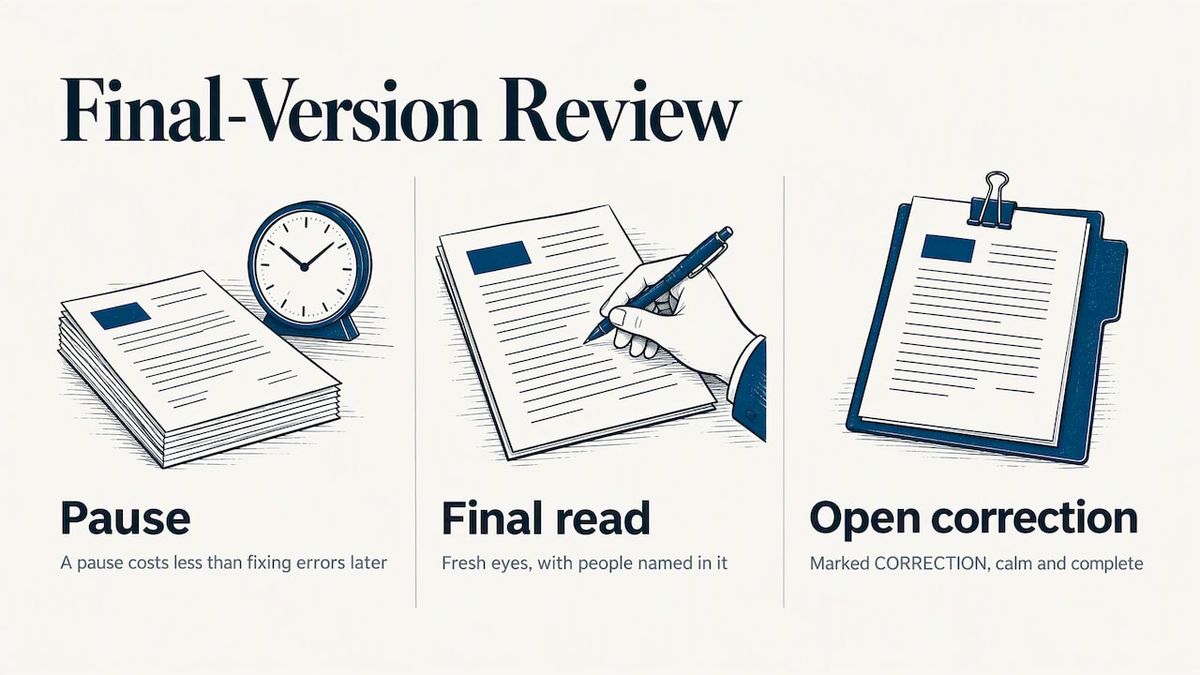
Our view is simple. Treat publication as the moment the release stops being a draft. Because editorial review at News Today runs on an instant or 24 to 48 hour basis, there is a natural point to read the text one more time, with fresh eyes and with the people named in it. Use it.
When something still slips through, we would rather you correct it openly than hide it. A release marked CORRECTION, calm and complete, tells journalists you take accuracy seriously. That reputation is worth more than the discomfort of admitting a slip, and it is the reason we hold to strict editorial standards for credibility and accuracy in the first place.
— Matthew
Getting the correction out on News Today
If your original went out through us, or you want a correction published alongside new news, you can submit your corrected release like any other. Write it as a standalone release, label it CORRECTION and point back to the original, which is easy to find in the archive of published releases. A Single Release costs $39, and agencies or larger teams with frequent needs can ask about custom and enterprise options on the same page. You can read how we approach accuracy on our editorial page.
Checklist before you hit send
- Every date, figure, name and title checked against a primary source.
- Each quote approved word for word by the speaker, after the final edit.
- One authorized approver has signed off the whole release.
- Boilerplate, captions, image credits and links checked.
- Contact details tested.
- Compliance-sensitive claims (price, savings, health, finance) reviewed by someone who knows the rules.
- A clear plan for who sends a correction, and how, if something slips through.
FAQ
Can I edit a press release after it has been distributed?
Usually not. Many distribution tools and outlets treat the first version as final, and some state that edits are possible only before the send time. Plan on issuing a new, labeled correction instead and ask individual editors to update their pages.
What should a press release correction say?
It should state that it is a correction, name the original by headline and date, explain the error and give the right information. Add that all other details are unchanged. Avoid excuses, vendor blame and softer words such as “clarification”.
Do I need to tell journalists personally?
Yes, for anything material. A distribution alone may not reach the reporter who already wrote a story. A short, direct email with the corrected text lets them update quickly, which fits the duty of fair correction in the MEAA Code of Ethics.
Does the person I quoted have to approve changes?
If their words change in any way, they should see the new version. Approval to be quoted is not approval of the final text, so send the exact wording, name and title again before you publish.
Is a press release error ever a legal issue in Australia?
It can be, when a statement misleads consumers about prices, savings or products. Courts have ordered corrective advertising in some cases. If your error is of that kind, talk to a consumer law solicitor before you publish.
Sources
- What happens when a mistake is made? How corrections work in journalism
- Community media kit, including MEAA Code of Ethics
- Frequently asked questions, ecommercenews.com.au
- Frequently asked questions, techday.com.au
- Court finds outdoor store misled customers, ACCC
- ACCC v Clarion Marketing Pty Ltd [2009] FCA 1441
- ASIC sues Harvey Norman over ads, The Guardian
- Who Should Approve a Press Release Quote Before Distribution?
- Press Release Quote Approval Form, FileIt