To send a media release in Australia, write one page that answers who, what, when, where and why in the first paragraph, then send it to the specific news desk or editor who covers your topic, with images and a spokesperson's phone number attached. You can email newsrooms directly, or publish and distribute it through a release service. Either way, the work that decides the result happens before you hit send: the angle, the list and the timing.
This guide walks through each step, with real examples of how Australian newsrooms ask to be contacted.
TL;DR
- Keep the release to one page, lead with the news, and put a named spokesperson with a direct phone number at the bottom.
- Send it to a news desk address or a named journalist who covers your subject, not to a generic inbox or a mass list.
- Attach or link a media kit: a fact sheet, high-quality images and, where you have it, video.
- Use an embargo only when you need one, and set it so morning outlets can still run the story.
- If you would rather not build lists yourself, News Today publishes your release instantly and distributes it for a $39 one-off fee.
Table of Contents
- Before you send: is it actually news?
- How to format an Australian media release
- Build the package, not just the release
- Who to send a media release to
- How to send it: email, a release service, or both
- Timing and embargoes
- Follow up without being a nuisance
- Our perspective: why distribution is only half the job
- Common mistakes that sink a release
- A simple send checklist
- Publish your release with News Today
- FAQ
- Sources
Before you send: is it actually news?
Most releases that go unused fail at this point, not at the sending stage. A journalist asks one question: why would my audience care today? A new hire, an anniversary or a product tweak rarely clears that bar. A new local service, a survey result, a funding round, a community event with a date, or a clear opinion on something already in the news usually does.
The Community Media Kit from the Western Australian Office of Multicultural Interests advises describing your key message in one sentence and focusing on a single issue. Try it. If you cannot say the news in one sentence, the release is not ready, and no distribution method will fix that.
Two quick tests help:
- Local relevance. Does the story matter to people in a specific suburb, state or industry? Say where, by name.
- A face and a voice. Is there a real person who can be quoted and photographed? Newsrooms want people, not only organizations.
How to format an Australian media release
Keep the format plain. Journalists skim dozens of releases a day and reward the ones they can lift from quickly.
The structure that works
The same community media kit sets out the standard layout: the words MEDIA RELEASE at the top, a date, the five Ws in the first paragraph, one page in length, and a contact name with a direct phone number for a spokesperson. Here is how that looks in practice:
| Element | What to include |
|---|---|
| Label and date | MEDIA RELEASE, then the date, at the top |
| Headline | One line, plain, with the news in it |
| First paragraph | Who, what, when, where, why, in two or three sentences |
| Body | Detail in descending order of importance, plus one quote |
| Quote | A named person with a title who says something worth printing |
| Note to editors | Photo opportunities, logistics, availability for interviews |
| Contact | Name, mobile and email of a spokesperson who will pick up |
Write it like a news story
Write in the third person, in the style of a short news article. Skip superlatives such as "world-class" or "revolutionary" unless a number backs them up. A sentence like "The program has placed 412 apprentices in regional Victoria since 2023" does more than any adjective.
The guidance also recommends a "Note to the Editor" at the end, covering photo opportunities and practical details. It is a small addition that makes a release easier for a busy newsroom to use.
Name a spokesperson who is reachable
Journalists often need a quote, a clarification or an interview before a story can run. If your contact's phone is off for the week, the story goes to someone else's release. Put a mobile number on the page and make sure the person is briefed and available on the day you send.
Build the package, not just the release
A release alone is the minimum. One Australian PR agency, Herd MSL, describes a campaign for a consumer brand in which a content package of video, still images and audio was prepared for launch, alongside a credible third-party spokesperson who could give first-hand context on a difficult topic.
You do not need a campaign budget to borrow the idea. For most organizations, a practical package is:
- A one-page fact sheet with approved key details about your organization.
- Three to five high-resolution images, with captions and photo credits.
- A short video clip or b-roll if the story is visual.
- A headshot of the spokesperson.
- A link to a page on your own site where everything can be downloaded.
The community media kit makes the same point: attach a fact sheet with approved key information, plus quality images and video, so a journalist does not have to chase you for basics.
Who to send a media release to
This is the question behind most searches, and the honest answer is: the person who already covers your subject. A release sent to twenty well-chosen contacts beats one sent to two thousand random ones.
Start with news desks
Most Australian outlets publish a dedicated address for story submissions. A few examples from their own pages:
- Mumbrella lists a news address for general media releases, with a separate process for opinion pieces.
- Radio Today asks for releases and pitches to go to its editor address, covering radio, audio and podcasting.
- SBS asks that media releases go to its News team at a named email address, and keeps a separate list of contacts for program and corporate enquiries.
- The Urban Developer runs a contribution enquiry page for property and development stories.
The pattern is clear. Each outlet decides where releases should go, and it is usually written on the About or Contact page. Check it every time. Contact details change, and an address that worked last year may now be dead.
Match the outlet to the story
Think in layers, and send different versions to each:
- Local and regional. Community newspapers, regional radio and local TV news. They want the suburb, the town and the local name.
- Trade and industry. Specialist publications such as those above read releases closely, and their audiences are exactly the buyers or peers you want.
- Metropolitan and national. Harder to reach, and they need a genuinely broad angle or a strong exclusive.
- Independent and digital-first. The landscape is diversifying. Outlets such as Man of Many have joined the Local & Independent News Association, a sign that independent and hyperlocal publishers deserve the same careful targeting as legacy mastheads.
Find a named journalist
A news desk address is a good start, but a named reporter is better. Read the last ten stories on your topic at an outlet and note who wrote them. Address your email to that person, mention one of their recent pieces, and explain in a line why your story fits. Keep a simple spreadsheet: outlet, journalist, beat, date contacted, response.
How to send it: email, a release service, or both
Sending by email
Email remains the standard. A workable email looks like this:
- Subject line: the news, in plain words, under about ten words. "Ballarat bakery trains 40 refugee apprentices" works better than "Press release: exciting announcement."
- Body: paste the release into the email itself. Many journalists will not open attachments from strangers.
- Opening line: one sentence saying why this suits their audience.
- Images: link to a download folder or attach small previews, so the message does not bounce.
- Sign-off: your name, role and mobile.
Send individually, or in small groups using blind copy only when a journalist should not see the other recipients. Never put a long list of strangers in the visible "To" field.
Using a distribution service
Building and maintaining lists takes time. A release platform publishes your story on a public news page, helps it show up in search, and delivers it to media contacts, so you reach more outlets than you could by hand. That is the role we play. You submit through our submission page, the release goes through editorial review, and it is published and distributed. The platform is aimed at businesses, PR agencies, startups and nonprofits who want their news visible without running a media relations desk.
Many teams do both: distribute through a service for reach and long-term discoverability, and send a personalized email to the three or four journalists who matter most.
Timing and embargoes
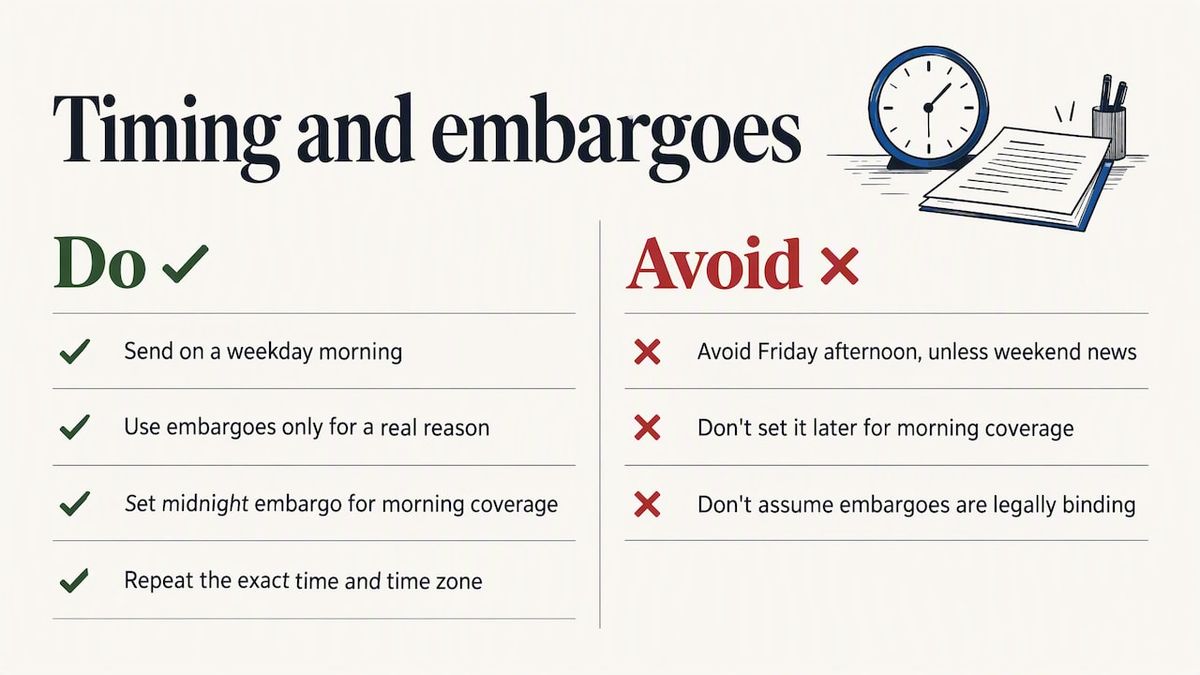
Send on a weekday morning, early enough for a newsroom to plan its day. Avoid Friday afternoon, when desks wind down, unless the story is about the weekend.
An embargo asks journalists to hold a story until a set date and time. The community media kit notes that it is not legally binding, and that respecting embargoes is a professional standard. Use one only when you have a real reason, such as a report launch, a ministerial announcement or an event with a fixed start.
The kit also gives a practical rule: if you want both morning newspapers and later media to cover the story, set the embargo for midnight (12am) on the day of publication. Set it for later in the day and you effectively shut out morning print and radio. Put the embargo in the subject line and again at the top of the release, with the exact time and time zone, which matters in Australia when you are sending across state lines.
Follow up without being a nuisance
Many journalists will not reply to a release, and silence is not rejection. Still, a short follow-up helps. Allow a day, then send one brief message or make one call to your key contacts. Lead with something new: a fresh quote, an extra image or a time for an interview. Do not ask "did you get my email?"
Be ready when they do call. Have the spokesperson briefed, the facts checked and the images on hand. If a journalist comes back with a question, answer within the hour.
When a story has run, send it more widely. You can then use the coverage as proof for outlets that were waiting to see if anyone else cared, and add the journalists who responded to your list for next time.
Our perspective: why distribution is only half the job
We see a lot of releases come through our editorial queue, and the pattern is consistent. The ones that perform are not the loudest. They are the ones with a clear first paragraph, a named person who can be quoted, and a reason to exist today.
That is why we built our service around two things at once. First, speed: instant posting, with a review that takes 24 to 48 hours at most, so news does not go stale. Second, standards: our editorial process checks for credibility and accuracy, because a distribution network is only worth reaching if the content on it can be trusted by journalists and readers.
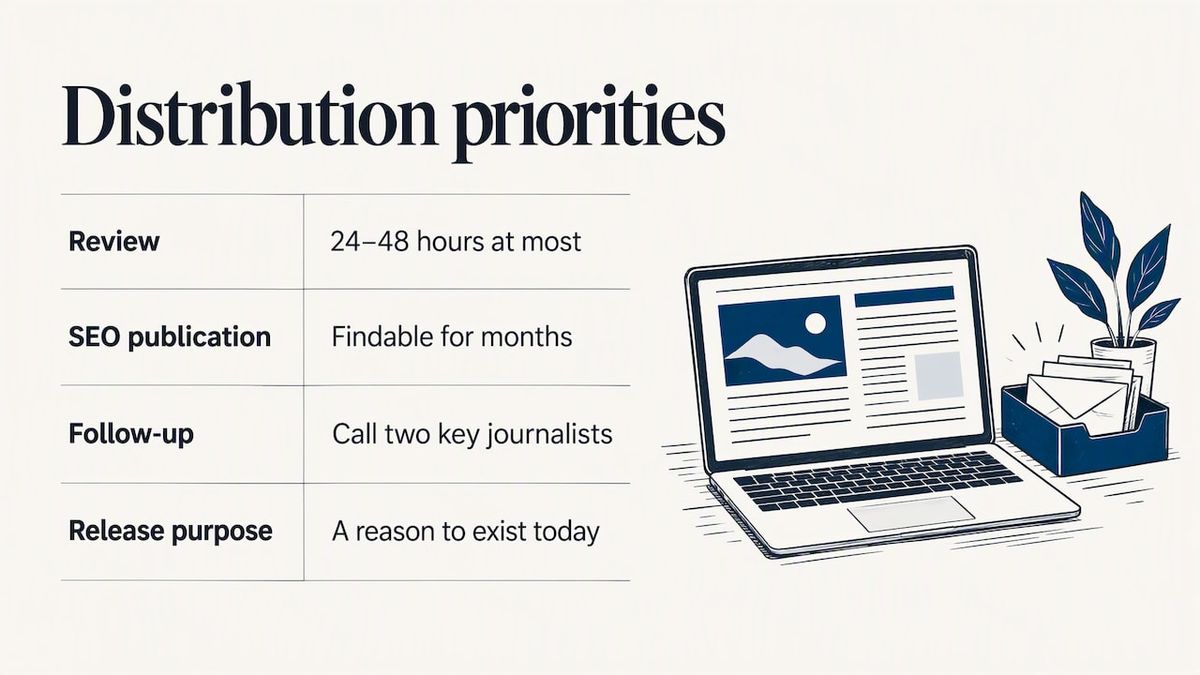
We also think SEO is underrated in media relations. A release read by one editor on Tuesday is useful. A release that stays findable on a news page for months, when a customer or a reporter searches your name or topic, keeps working. Search-optimized publication gives a release a long life that an email in a crowded inbox never has.
Our advice is to treat a release service as part of the mix, not a substitute for relationships. Publish and distribute widely, then pick up the phone to the two journalists who should care most.
— Matthew
Common mistakes that sink a release
- Burying the news. If the point is in paragraph four, it will not be read.
- Writing an advertisement. Claims without evidence read as marketing, and newsrooms discard them.
- Going too long. One page is the standard in the Western Australian guidance. If you need more, put it in the fact sheet.
- No local angle. Name the town, the suburb or the state. Regional editors especially want to see where the story is.
- Unreachable contacts. A dead phone number ends the story.
- Mass emailing. Irrelevant sends train journalists to ignore you.
- Ignoring independent outlets. Smaller digital publications often reply faster and reach exactly the niche you want.
A simple send checklist
- Write the key message in one sentence.
- Draft the release on one page, with the five Ws up top.
- Add a quote, a note to editors and a contact with a mobile number.
- Prepare the fact sheet, images and any video.
- Build a list of 10 to 20 relevant outlets and named journalists, checking each outlet's contact page.
- Decide whether you need an embargo, and if so set it for midnight.
- Send on a weekday morning, personalized to each recipient.
- Publish and distribute through a release service for broader reach and search visibility.
- Follow up once, with something new.
- Record results and refine next time.
Publish your release with News Today
If you want your release live quickly and distributed without building a list from scratch, a single release on News Today costs $39 one-off. You can see how pricing works, including the custom and enterprise option for agencies and larger teams, and then submit your release when it is ready. To see what a published release looks like, browse the latest releases from Australian businesses.
FAQ
Who do you send a media release to?
Send it to the journalist or news desk that covers your subject and location. Check each outlet's About or Contact page for its news address, and prefer a named reporter whose recent stories match yours. A short, relevant list works better than a large one.
Should I paste the release into the email or attach it?
Paste it into the body of the email. Journalists are often wary of attachments from senders they do not know, and a pasted release can be read at a glance. Link to images and the fact sheet rather than attaching large files.
What is the best time to send a media release?
A weekday morning is usually safest, early enough for newsrooms to plan their day. If you use an embargo and want morning papers and later media to run the story, set it for midnight on the day of publication.
Do I need a distribution service if I can email journalists myself?
Not necessarily, but it saves time and extends your reach. Email suits a handful of priority contacts. A distribution service publishes the release online, makes it searchable and gets it to more media than you could list by hand. Many organizations use both.
Sources
- Community Media Kit, WA Office of Multicultural Interests
- Herd MSL Campaign Spotlight: Always Discreet's Generation Invisible
- About Mumbrella
- About Radio Today
- Media Contacts, SBS
- Contribution Enquiry, The Urban Developer
- Man of Many joins the Local & Independent News Association