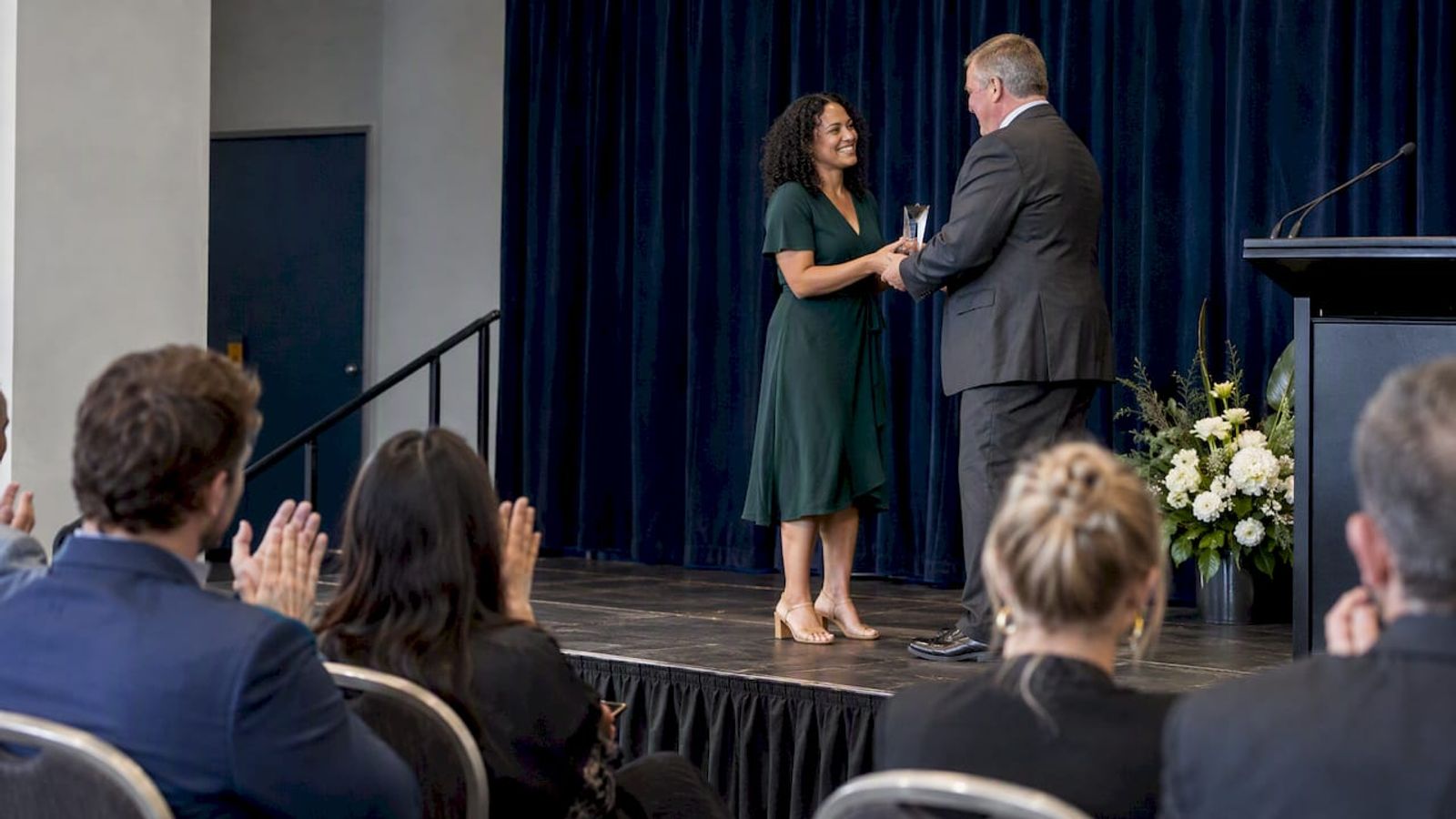
An award press release works when it treats the win as news for someone beyond your own team. Lead with the key facts (who won what, from which awarding body, and when), add a quote from a senior leader, show why the win matters to your customers or industry, and issue it quickly after the announcement. This guide covers each step, gives you a template you can adapt, and then shows how a rebrand announcement follows much the same logic.
TL;DR
- Issue the release as soon as the result is public. Waiting even a day or two can make the story feel old.
- Put the main facts in the first paragraph: the award, the category, the awarding body, the date and why it matters.
- Name the awarding organisation and link to its official results page, so a journalist can verify the win in seconds.
- Give editors a reason to care beyond the trophy: a customer benefit, an industry trend or a business milestone.
- A rebrand release follows the same shape: the reason for the change, what is new, and what it means for customers.
Table of Contents
- When to issue an award press release
- What to include in an award announcement
- Make the win credible and newsworthy
- An award press release template
- Rebrand press releases: the same discipline
- Distribute the release where it will be read
- Common mistakes to avoid
- FAQ
- Sources
When to issue an award press release
Issue one when the award is a real, independent recognition and the result is public. A shortlisting, a finalist place and a win can each be news, but the bigger and more competitive the award, the stronger the story.
Timing matters more than most people expect. Momentum Media, which runs trade publications and awards programs in Australia, advises organisations to prepare a media release before finalists or winners are announced and to issue it as soon as possible afterwards, because delaying even a day or two can make the story look old on social media and in trade press.
In practice that means drafting before the night. Write the release with a blank for the result, get the quote approved in advance, and have the photo ready. When the winner is called, you change a few lines and publish.
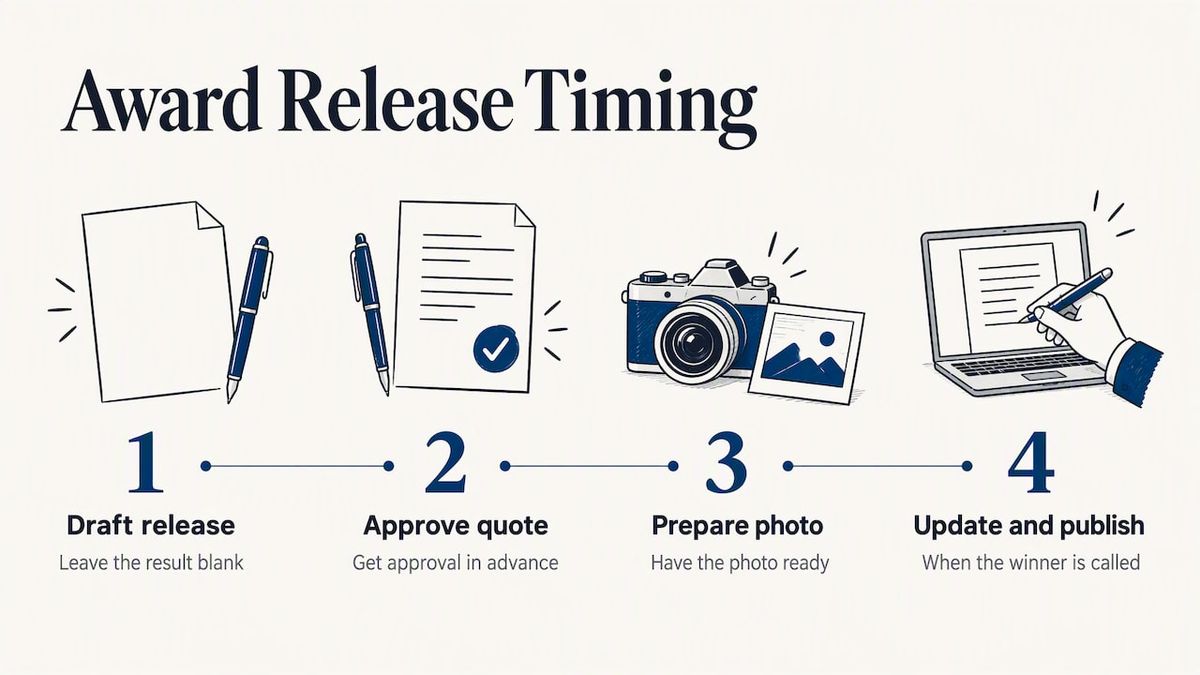
Some announcements are time-dependent, such as prize winners that are kept under wraps until a ceremony. Museums & Galleries NSW notes in its guide to writing a press release that a release can announce a prize, that you should include the release date, and that an embargo may be used for time-dependent announcements such as prize winners. Use "FOR IMMEDIATE RELEASE" only when the release is ready to be published straight away.
When not to issue one
Be honest about whether the award is newsworthy. If the "award" is a pay-to-enter listing with no judging, a journalist will see through it, and so will your customers. If the recognition is minor, consider a social post, a note in your newsletter or a line on your website instead. Keep your best press release for wins that carry weight with the people you want to reach.
The Australian government-funded FRDC adds a practical test in its guide to writing a media release: do not issue a release unless your organisation is prepared for media enquiries. If a reporter calls the contact on your release, someone needs to pick up and be ready to talk.
What to include in an award announcement
A good award release is short, factual and easy to lift into a news story. Here is the order we recommend, which follows the standard structure set out by the Australian guides.
- Headline. Active, specific and no longer than 10 words, as the Museums & Galleries NSW template advises. Name the winner and the award.
- Dateline and release line. City, state and date, plus "FOR IMMEDIATE RELEASE" or the embargo details.
- First paragraph. Two or three sentences covering the key facts. The FRDC guide says to lead with the who, what, where, when, why and how, and the same advice applies to every release.
- Award context. What the award is, who runs it, how many entries or categories there were, and how winners are chosen.
- Why you won. The specific achievement behind the result. The Australian Institute of Marketing recommends explaining why the organisation won and including the judges' comments.
- Quotes. One from a senior leader at your organisation and, if you can get one, one from the awarding body or a judge. The FRDC says quotes should be attributed to a named person.
- Current business news. The AIM suggests strengthening the story with real developments such as growth, new clients, team expansion or significant projects.
- Organisation background. A short final paragraph about who you are.
- "ENDS" and contact details. A named person, a phone number and an email address.
The FRDC also says each paragraph should be less important than the one before it while still adding value. That is the inverted pyramid: an editor who stops reading after paragraph three still has the story.
On length, there is no official limit. Our advice is to keep it to a single page: if the release runs on, you are probably repeating the award details or padding the background.
Formatting for editors
The same Museums & Galleries NSW guide recommends double spacing, an easy-to-read font and wide margins, active voice, and the main facts in the first paragraph. These are small points, but they make a release easier to read and to mark up.
Make the win credible and newsworthy
Most award releases look alike: company name, award name, a quote about being honoured, a boilerplate. Editors receive dozens of them. Yours needs a reason to be picked up.
Give the story a wider hook
Inside Small Business, in a 31 July 2025 article on what a good pitch looks like, cautions that award releases are often ignored because they assume the award itself is newsworthy, without explaining why a journalist's readers should care.
Ask yourself what the win says about something bigger:
- Does it reflect a trend in your industry, such as a shift to sustainable packaging or to regional service delivery?
- Does it change something for customers, such as faster service or lower cost?
- Does it mark a milestone, such as a tenth year in business or a first national win by a regional firm?
- Is there a local angle for a suburban or regional paper, such as a team member who grew up in the town?
One clear angle in the headline and first paragraph beats three vague ones.
Let the facts do the work
An award release is a record of third-party recognition, not an advertisement. Skip "world-class", "revolutionary" and "industry-leading" unless the judges used the words, and then quote them as the judges' words. State the achievement plainly: what you did, what the judges said, what it produced.
Give a journalist everything they need to verify:
- the full official name of the award and the category
- the name of the awarding organisation
- the date of the result
- a link to the official results or winners page
When the result came from a public vote rather than a panel, say so and explain how voting worked. A published page from a people's choice voting platform shows the kind of detail worth referencing, such as the categories, the voting modes and how results were counted. If your award was decided that way, a short line on how many votes were cast, or how voting was run, makes the claim much easier to trust.
Use real numbers
Numbers turn a pleasant story into a credible one. If you can say how many entries were judged, how many customers you served last year or how much a project saved, add it, as long as you can stand behind it. Never invent a statistic, and do not round up.
An award press release template
Melbourne Royal, for example, gives Australian Food Awards winners a marketing toolkit that includes a media-release template. If your awarding body offers one, start there for the correct wording of the award name, then adapt it. If not, use the template below.
FOR IMMEDIATE RELEASE
[Date]
[Headline: Organisation wins Award Name for specific achievement]
[City, State]: [Organisation] has won [Award Name] in the [Category] category at the [Awarding Body]'s [Event or Program Name], recognising [specific achievement in one clause]. The result was announced on [date].
[Second paragraph: what the award is, who runs it, how many entries or finalists there were, and how winners are selected. Link to the official results page.]
[Third paragraph: why you won. What the judges noticed. Include the judges' comments if you have them.]
"[Quote from a named senior leader about what the win means for customers or the industry, not just for the team]," said [Name, Title].
[Optional quote from the awarding body or a judge.]
[Fourth paragraph: current news that gives the win context, such as growth, a new service, a new office or a major project.]
About [Organisation] [Two or three sentences: what you do, where, for whom, and since when.]
ENDS
Media contact: [Name, role, phone, email]
[Note: high-resolution photos and logos available on request or at a link.]
A worked example
Here is the opening of an illustrative, fictional release, to show how the first paragraph should read:
Hobart Bakery Wins National Sustainability Award for Zero-Waste Production
Hobart, TAS: Harbour Street Bakehouse has won the Small Business Sustainability category at the Example Food Industry Awards, after cutting its production waste to near zero in 18 months. The winners were announced in Sydney on [date].
The headline is under 10 words, names the winner and the achievement, and the first paragraph carries the who, what, where and when in two sentences. The "why it matters" follows in paragraph two. Adapt the structure, not the wording.
Rebrand press releases: the same discipline
People who search for award releases often need a rebrand announcement next, and the two share the same principle: give the reader a reason, not just the news.
A rebrand release should explain the strategic reason for the change, such as growth or a shifting market, describe the new identity, and show how the change serves customers and the industry. The Digital Economy Council of Australia's announcement of its evolution from Blockchain Australia is a clean Australian example. In 2024 the organisation broadened its remit to represent Australia's wider digital economy, and it announced the change as it marked its tenth year and expanded its membership categories.
Another example is the payments company that changed its name from DiviPay to Weel. Fintech Australia reported that the company rebranded in 2022 after its client base grew 200% in a year, as it prepared for international expansion. The same report ties the rebrand to fragmented spend-management tools and the need to support growth while keeping workplace culture intact.
What to take from these:
- Anchor it to a milestone or a reason. A tenth anniversary, rapid growth or a wider remit all give editors a story. "We wanted a fresh look" does not.
- Say what changes and what does not. Customers want to know whether the service, pricing, contacts and web address stay the same. State this plainly.
- Explain the name. If the name has a meaning, give it in one sentence.
- Include the practical details. The effective date, the new logo and website, and who to contact with questions.
- Quote a leader about the customer benefit. Not about the logo.
Use the award template above as the skeleton: headline, dateline, first paragraph with the key facts, the reason, a quote, the details, background and contact.
Distribute the release where it will be read
Writing is half the job. Send the release to journalists who cover your industry or region, and publish it somewhere it can be found later. Our guides on how to send a media release in Australia and on press release syndication walk through the options, and earned media metrics shows what to track once it is out.
If you want one place to publish and distribute, we built News Today for exactly this. You submit your release, it goes through editorial review (our claim is an instant or 24 to 48 hour review, depending on the submission), and it is published with SEO-optimised distribution to journalists and media outlets across Australia and beyond. A single release costs $39 one-off. Agencies and enterprise teams can ask about custom packages on the pricing page.
When the release is ready, you can submit your press release directly. Attach a quality photo, such as the trophy or the team on the night, and a link to the official results page.
Send it to the right people
A general blast rarely works. Build a short list instead:
- The trade publication for your industry.
- The local and regional papers and radio where you operate.
- The awarding body, which often shares winners' news on its own channels.
- Any journalist who has written about your sector in the past few months.
For the journalists you know, a short personal note with the release pasted into the email body (not just attached) lifts your chances. Our guide to education press releases and app launch release guide show how the same approach adapts to other kinds of news.
If you spot an error after publishing
Check names, category titles and dates twice before you send. If a mistake does get out, our guide to a press release correction explains how to fix it. Award names are the most common slip, so copy them from the awarding body's page rather than from memory.
Common mistakes to avoid
- Burying the award. If the win is the news, it belongs in the headline and first sentence, not in paragraph four.
- Writing about yourself, not the reader. Swap "we are thrilled" for what the win means for customers, patients, members or the community.
- Vague claims. "Recognised for excellence" says nothing. "Recognised for cutting delivery times by a third" says something, provided it is true and you can show it.
- Missing the verification link. A journalist who cannot confirm the win in a minute will move on.
- Posting late. The news fades quickly. Draft in advance and approve the quote before the event.
- Unapproved quotes. Always get sign-off from the person quoted, and from the awarding body if you quote it.
- No contact person. A release without a reachable name and number is a missed chance.
- Overstating the award. Describe a finalist place as a finalist place, and a category win as a category win. Accuracy protects your reputation.
Treat the release as a record you will point to for years. Your own website, sales decks and tender responses will link back to it, so make it accurate and easy to verify.
FAQ
How long should an award press release be?
Keep it to one page. The Australian guides stress short, targeted releases with the main facts first, and none of them rewards padding. If you need more room, put supporting material such as photos, the full judges' comments and background on a linked page rather than in the release body.
How soon after winning should I publish?
As soon as the result is public. Momentum Media advises issuing the release as soon as possible after the announcement, since even a day or two of delay can make the story look old. Prepare the draft and the approved quote before the ceremony so that you only need to fill in the result.
Should I write a release for being a finalist?
It can be worth it when the award is competitive and well known, and especially in regional or trade media. Be clear that you are a finalist, not a winner. For minor shortlists, a social post or newsletter item is usually enough.
What makes an award release credible?
A named independent awarding body, the exact award and category, the date, and a link to the official results page. Add the judges' comments where you have them, and keep the language factual. Boastful wording makes a release read like an advertisement.
Can I use the same structure for a rebrand announcement?
Yes. Lead with the change and its date, explain the reason, describe what is new and what stays the same, add a leader's quote about the customer benefit, and close with background and contact details. The DECA and Weel announcements above are good Australian models.
Sources
- Writing a press release, Museums & Galleries NSW
- Guide to writing a media release, FRDC (May 2024)
- Promoting your participation, Momentum Media
- Turn your award win into a sales tool, Australian Institute of Marketing
- PR for small-business owners: what a good pitch really looks like, Inside Small Business
- Blockchain Australia evolves to Digital Economy Council of Australia, DECA
- DiviPay unveils bold new brand, Fintech Australia
- Marketing & Promotional Tool Kit, Melbourne Royal
- Awards voting page, Izivote