A press kit and a media kit are the same thing in many Australian workplaces, and the two names are used interchangeably. Where a difference is drawn, it comes down to audience. A press kit is built for journalists who might write about you. A media kit is often built for people who might pay to work with you, such as advertisers, sponsors and media buyers. If you want coverage, build a press kit. If you sell audience reach, build a media kit. If you do both, one organised package with two sections will do.
This guide explains where the terms overlap, where they split, what goes into each, and how to keep the package current once it exists.
TL;DR
- "Press kit" and "media kit" are often used as synonyms, especially in ecommerce and small business. The split appears when you ask who the kit is for.
- A press kit helps journalists write a story: background, facts, quotes, images and contact details. A media kit for advertising shows buyers your audience, formats and rates.
- A press release is one announcement. The kit is the supporting package around it.
- Keep it online, current and easy to download. Electronic kits are now more common than hard copy, according to Tourism Australia.
- Once the kit is ready, pair it with a well-written release so journalists have both the story and the proof.
Table of Contents
- Press kit vs media kit at a glance
- Why the two terms get mixed up
- Where the press release fits
- What to put in a press kit
- What to put in an advertising media kit
- Australian media kit examples worth studying
- Which one do you need?
- How to organise it and keep it current
- Getting the kit in front of journalists
- Publish the release that points to your kit
- FAQ
Press kit vs media kit at a glance
Shopify's Australian guide notes that in ecommerce "press kit" and "media kit" are often used interchangeably, while in traditional publishing an advertising media kit shows media buyers audience demographics and examples of sponsored content. That is the cleanest way to think about it: one word, two jobs.
| Press kit | Media kit (advertising or sponsorship) | |
|---|---|---|
| Main reader | Journalists, editors, producers | Advertisers, sponsors, media buyers, collaborators |
| Goal | Earn editorial coverage | Win paid placements or partnerships |
| Core content | Background, fact sheets, bios, quotes, images, releases, contacts | Audience size and demographics, formats, packages, rates, testimonials |
| Tone | Factual, neutral, ready to quote | Commercial, data-led, persuasive |
| Updated | When news, people or products change | When audience figures or rates change |
| Who usually needs one | Businesses, startups, nonprofits, institutions | Publishers, creators, podcasts, associations, event organisers |
Many organisations need only the left-hand column. A café, a software startup or a charity launching a campaign wants stories written about it, not advertising revenue. For them, the press kit is the right tool, whatever the label on the folder.
Why the two terms get mixed up
Both packages are collections of material that make a decision easier for someone outside your organisation. Both contain an "about us", contact details and visuals. Both live in the same place: a page on your website, a downloadable file or an email attachment.
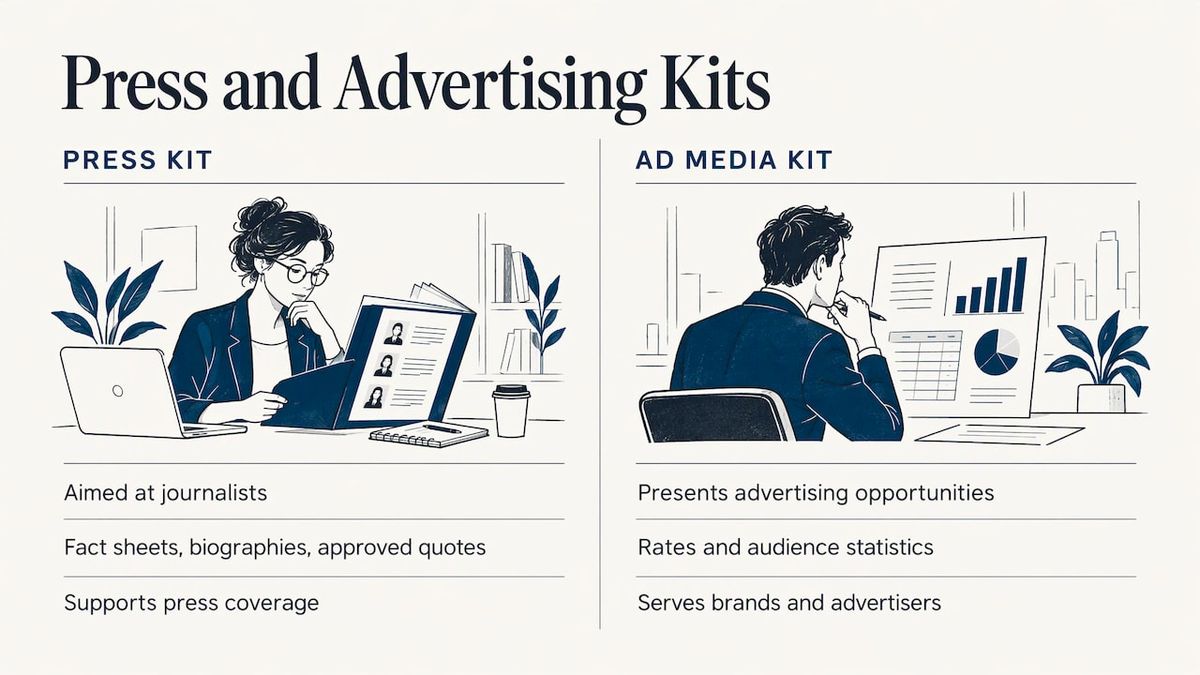
A media kit is also the more general word. One agency explainer says a press kit is aimed at journalists, whereas media kits can serve purposes beyond press coverage such as presenting advertising opportunities, collaboration options, audience demographics, metrics, services, testimonials and pricing. So every press kit can fairly be called a media kit, but not every media kit is a press kit.
A practical rule: look at what is inside. If there are rates and audience statistics, it is a media kit in the advertising sense. If there are fact sheets, biographies and approved quotes, it is a press kit.
Where the press release fits
A press release is one document announcing one piece of news. The kit is the package around it. One agency guide describes the release as a single announcement, with the kit holding the supporting background: specifications, biographies, quotations, images and contact details.
Think of the release as the headline and the kit as the research folder. A journalist who reads your release at 4 pm and has a deadline at 5 pm will go looking for a spokesperson photo, a correct company description and a phone number. If those are in your kit, they will use them. If not, they may move on.
If you are preparing a release to go with your kit, our guide on how to send a media release in Australia covers the practical steps, and press release quotes shows how to write the lines journalists lift into stories.
What to put in a press kit
Tourism Australia's guide for working with the media is a good official benchmark. It recommends including current media releases and fact sheets, company history, recent awards, product and executive biographies, high-resolution images and media contact information. Shopify's Australian guide adds items such as the story and mission, a product or service overview, prior coverage, social links, name pronunciation, charity work, customer success stories and reviews.
Here is how to turn that into a working checklist.
The essentials
- A short company overview. Who you are, what you do, where you operate and who you serve, in about 100 words. Write it so a journalist can paste it without editing.
- A fact sheet. Founding year, headcount, locations, key products, milestones. Adoni Media, an Australian agency, says a fact sheet should offer approved, accurate facts and multiple story angles.
- Current releases. Your latest announcement and a few recent ones, so the reader sees a pattern of news rather than a single event.
- Biographies. Founders, executives and spokespeople, each with a headshot and two or three lines on why they are qualified to comment.
- High-resolution images. Tourism Australia says photographs for publication should be at least 300 dpi, with clear download instructions and copyright information. Include logos in more than one format and product or team photos.
- Contact details. A named person, a direct phone number and an email address. Journalists on deadline will not fill in a web form.
The extras that earn their place
- Awards and recognition, with the year.
- Previous media coverage, linked.
- Approved quotes from your spokesperson on common topics.
- Customer stories or case studies, if you have permission.
- Video links, such as a short founder interview or product demonstration.
- Social media handles.
Tourism Australia also says a kit should give media representatives thorough background on the topic, the company and the spokesperson, in various formats. That is a useful test for every item you add: does it save the journalist a phone call?
What a journalist needs for event news
If the story is an event, the basics matter more than any extras. A community media guide from the Western Australian government recommends a release that states who, what, when, where, why and how, and clearly gives the event date, time, location and name. It also suggests one-page releases of five or six paragraphs, with quotes, background and a contact name and phone number. Put that one-pager at the front of the kit, and keep the rest behind it for those who want more.
What to put in an advertising media kit
An advertising or sponsorship media kit answers a different question: what will a brand get if it pays to work with you? The reader is a marketer comparing options, so the content is commercial and numerical.
Typical contents, drawn from the research on how these kits are structured:
- Audience size and channels (readers, subscribers, visitors, followers)
- Audience demographics and characteristics
- Advertising formats and sponsorship opportunities
- Rates or packages
- Testimonials and past partners
- Contact details for the sales or partnerships contact
This is the model publishers, creators and trade bodies use. Brands that buy creator sponsorships, for example through influencer partnership programs, review these kits to decide who to work with and at what price, so the numbers need to be clear and current.
Australian media kit examples worth studying
The examples below are advertising-style media kits from Australian organisations. They show what a commercial kit looks like when it is done properly. None is a press kit for journalists, which is a useful reminder of how differently the same label can be used.
| Example | Model | What it presents |
|---|---|---|
| National Gallery of Victoria, 2026-27 magazine media kit | Publisher | Distribution and readership information alongside advertising formats, rates and preferred-position loadings |
| FilmInk, 2025 media kit | Sponsorship | Readership, subscriber and visitor information, audience characteristics, advertising formats, promotional opportunities and stated rates |
| Housing Industry Association, 2024 media kit | Trade association | Audience channels, subscriber figures, events, sponsorship opportunities, advertising products, packages and prices |
What you can learn from them
- Lead with the audience. Each kit says who reads or attends before it says what you can buy.
- Make the offer concrete. Formats, packages and prices are stated, not hinted at.
- Give the reader a next step. A sales contact appears where a buyer would look for it.
- Date the document. The year in the title tells the reader whether the figures are current.
For a business seeking news coverage rather than ad revenue, borrow the discipline, not the content: be specific, be current and make the reader's next step obvious.
Which one do you need?
Use the goal, not the label, to decide.
- You are launching a product, announcing funding, opening a venue or sharing a campaign. You need a press kit. Reporters want facts, people and images.
- You run a publication, podcast, event or large community and sell sponsorship. You need an advertising media kit with audience data and rates.
- You are a startup, nonprofit or small business. Start with a press kit. Add a sponsorship section later only if you plan to sell it.
- You are an agency managing several clients. Build one kit template, then customise the overview, bios, images and contacts for each client.
The topic of your announcement also changes what goes first. A tech company launching software will lead with product screenshots and a demo link, which our guide to a press release for an app launch explores. A school or university will lead with people and outcomes, as in our piece on the education press release. An organisation celebrating recognition will want a clean summary of the honour, covered in our award press release guide.
How to organise it and keep it current
Tourism Australia notes that kits can be hard copy or electronic, including USB or email delivery, but that electronic kits are now more common. It also points out that journalists receive large volumes of material, so presentation matters.
A workable setup:
- Create a dedicated page on your website. Tourism Australia recommends an online news centre with accurate, up-to-date information and clearly shown update dates. Name it plainly, such as "Media" or "Press".
- Offer a single downloadable file as well. A PDF with the one-page overview, fact sheet and bios suits journalists who want everything at once.
- Store images in a folder with clear instructions. State the resolution, the permitted use and the copyright wording.
- Date everything. A visible "last updated" line builds trust and tells reporters the facts are current.
- Review it on a schedule. Check contacts, headcount, product names and awards at least when something material changes, and after every major announcement.
- Link it from every release. Add a line at the end of each release pointing to the kit, so a journalist who finds you through one story can find the rest.
Common mistakes
- Out-of-date contact details, which waste the one chance a journalist gives you.
- Low-resolution logos or photos that cannot be printed.
- Marketing copy where facts should be. Keep adjectives to a minimum.
- No named person. Generic "info@" addresses rarely get quick answers.
- Burying the kit. If it takes four clicks to find, it will not be used.
Getting the kit in front of journalists
A kit does nothing until someone sees it. The release is the vehicle: it tells the story, then points to the kit for depth. If you are unsure how releases travel online, our guides on publishing a press release online in Australia and press release syndication explain how distribution reaches readers and media outlets. You can also adapt the release for your own channels using our advice on sharing a press release on social media.
Publish the release that points to your kit
Once your kit is ready, the next step is putting the announcement in front of journalists and readers. News Today is a press release distribution service for businesses, agencies, startups and nonprofits. You submit your release, it goes through editorial review, and it is published and distributed to media outlets, with SEO-optimised syndication designed to keep it discoverable over time. Our positioning is faster turnaround, with instant publication and 24 to 48 hour review options.
A single release costs $39 one-off, and custom and enterprise packages are available for larger needs. See the pricing page for details, or submit your press release when your kit and release are ready. If you want to compare what you would spend, our breakdown of press release distribution cost in Australia sets it out.
FAQ
Is a press kit the same as a media kit?
Often, yes. In ecommerce and small business, the terms are commonly used interchangeably. Where they are distinguished, a press kit is for journalists and a media kit is a broader package that can also serve advertisers, sponsors and collaborators.
What is a press kit used for?
A press kit gives journalists the background they need to write about you accurately and quickly. It typically holds a company overview, fact sheet, biographies, images, recent releases and contact details. It saves reporters time and keeps the facts in the story correct.
What should a press kit include?
At minimum: an overview, a fact sheet, current releases, biographies, high-resolution images and a named media contact. Awards, past coverage, approved quotes and video links strengthen it. Keep everything dated and current.
Do small businesses and nonprofits need a press kit?
If you want media coverage, a press kit is worth having, whatever your size. A simple online page with a one-page overview, two or three bios, a logo and photos, and a direct contact is enough to start. You can expand it as your news flow grows.
What is the difference between a press kit and a press release?
A press release is one announcement of specific news. A press kit is the standing package of background material that supports it and every future release. You send the release when you have news, and keep the kit available all the time.