
A rebrand press release announces a new name, identity or positioning and explains why the change matters beyond your own walls. Write it when the change is real news, such as a new strategy, market, ownership structure or name. Lead with the five Ws, say what is changing and what is staying the same, and publish before the new brand goes live. A new logo on its own is usually a story for your own channels.
This guide covers when a rebrand deserves a press release, what to put in it, how to handle a name change, three Australian examples, and the timing that keeps the announcement from confusing customers.
TL;DR
- Issue a rebrand press release when the change reflects a meaningful shift in the business. A visual refresh alone is normally an owned-channel story.
- Open with who, what, when, where and why, then cover why now, what is different, what stays stable and what happens next.
- For a name change, give the reason for the new name and a clear timeline, and complete the legal steps (ASIC, ABN details) before you announce.
- Announce before the new brand launches, then follow up on social, email and your website.
- Include a quote from your CEO or leader, the new logo, and a short before-and-after comparison.
Table of Contents
- When a rebrand deserves a press release
- What to include in a rebranding press release
- Announcing a name change or new logo
- A structure you can adapt
- Three Australian rebrand announcements and what they teach
- Timing and messaging
- Adapting the release for startups and nonprofits
- Getting the release in front of people
- Publish your rebrand announcement with News Today
- Final checklist before you publish
- FAQ
When a rebrand deserves a press release
Not every rebrand is news. Shadow's 2026 guide says a rebrand is publicly newsworthy when it reflects a meaningful business change that matters beyond the company, for example a new strategy, market, product scope, ownership structure or customer proposition. It adds that a visual update alone is usually better told on your own channels.
A useful test: would a journalist, a customer or a supplier who has never heard of your design process care? If the answer is yes, because you merged with another business, expanded into new services, shifted from one purpose to another or changed your legal name, you have a story. If you only refreshed colours and a typeface, post it on your website and social accounts, and send it to your existing customers.
Good reasons to issue a release include:
- A merger, acquisition or consolidation. Two names become one, and people need to know who they are dealing with now.
- A shift in what you do. The old name no longer describes the business.
- A change in ownership or structure. A new parent company, a new group name or a spin-off.
- A repositioning for a new market. You are moving into a new customer segment or region.
- An organisation outgrowing its original purpose. Common in the nonprofit sector.
Shadow also warns against manufacturing newsworthiness. Be straight about the reason. Journalists and readers can tell when a routine design update is dressed up as a transformation.
What to include in a rebranding press release
Shadow's guide suggests a rebrand announcement should answer six questions: why change now, what prompted it, what the new brand means, what is materially different, what stays stable and what happens next. Build the release around them.
Start with the five Ws
Determ advises putting who, what, when, where and why in the first paragraph, so a reader gets the overview without finishing the release, and a journalist can write their own story from it. In practice, your first paragraph should name the company (old and new), state the change, give the date it takes effect and say in one clause why you did it.
Explain the strategic intent
Fuller, an Australian brand consultancy, says the first step in communicating a rebrand is to explain the strategic intent behind the decision, whether it comes from a merger, acquisition, consolidation, a new strategic direction, a new product offering or a changing business environment. Fuller also stresses that explaining why a change happened matters as much as explaining what changed.
This is the paragraph that separates a story from an advertisement. "We have a fresh look" is not a reason. "Our services have grown from X to Y, and our old name described only X" is.
Show what is different and what is not
Determ recommends contrasting the old and new brand, noting what remains the same for continuity, and including a short explainer video of under a minute. Fuller suggests naming the enduring parts of the organisation, such as its purpose and reason for existing, because a rebrand should not change those. It also notes that some organisations use a before-and-after approach so customers and staff can link the old identity to the new one.
For customers, the stable parts are often the most important lines in the release: same phone number, same ABN, same team, same pricing, same service standards. State only what is true for your business.
Add a quote, visuals and a timeline
A quote from the CEO, founder or chair should carry the reasoning in human language, not repeat the headline. Attach the new logo in a high-resolution format, a before-and-after image and, if you have it, a short video. Finish the body with what happens next: when the website changes, when signage and invoices update, and who to contact with questions.
Announcing a name change or new logo
A name change carries more weight than a logo update, because people have to find you under a new label. Truly Deeply, a Melbourne brand strategy agency, advises that if you are changing the name you must provide a rationale for the new name, and that the plan should set out the timeline, including when changes take effect and what customers can expect during the transition.
Get the legal steps done first
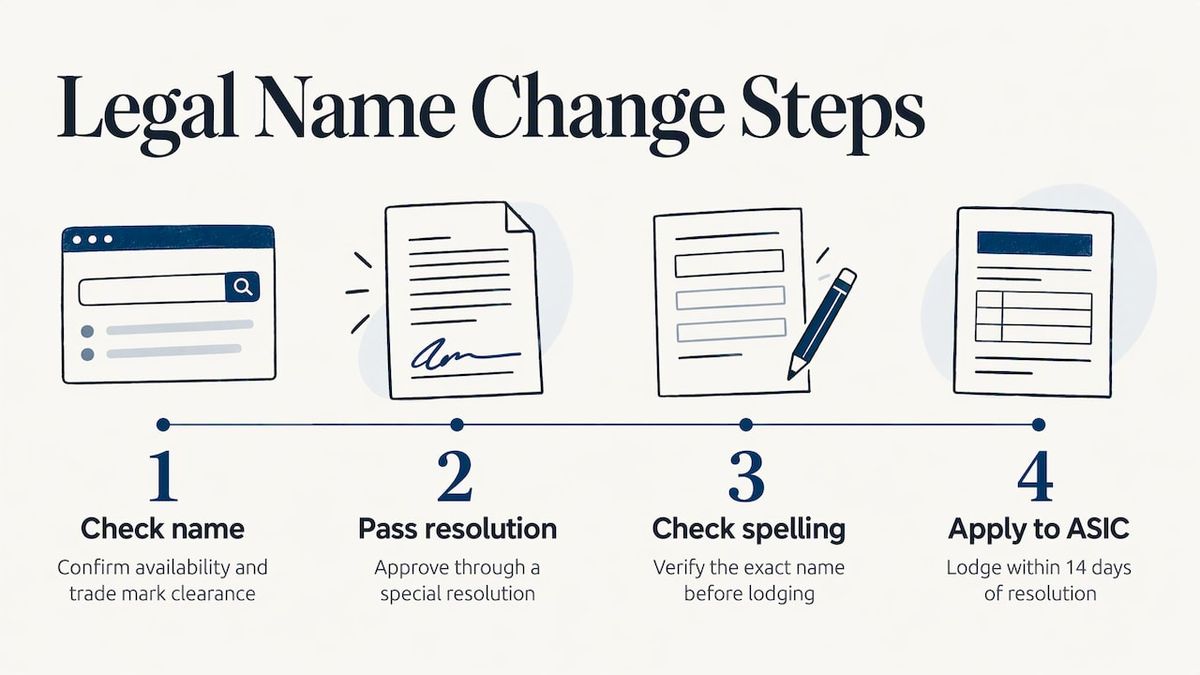
If you are a company, the name change is a formal process. According to ASIC, you must pass a special resolution and then apply to ASIC, checking first that the name is available. ASIC also suggests checking that the proposed name does not infringe a registered trade mark, and says the form must be lodged within 14 days of the resolution being passed or a late fee applies. It warns that an error in the new name cannot be updated once registered, so check the spelling before you lodge.
Why this matters for the press release: you want the announcement to match the registered name exactly. Announce a name that is not yet approved and you risk a correction later. If that happens, see our guide to fixing an error after publishing.
A new logo is the supporting detail
When a new logo comes with a name change or repositioning, describe what it signals. WEM Civil's announcement, covered below, explains that the new logo kept the "WEM" lettering and added the curvature of the Earth. That is a design decision tied to a business reason, which is exactly what readers want to see.
A structure you can adapt
Use this skeleton. The text in brackets is yours to fill in.
- Headline: [Old name] becomes [new name] as [reason in plain words]
- First paragraph: Who is changing, what the new name or identity is, when it takes effect, where the business operates and why the change is happening.
- Second paragraph: The strategic reason, with one concrete fact about how the business has changed.
- Quote: A leader explaining what the change means for customers or members.
- What is changing: Name, logo, website address, social handles, signage.
- What is staying the same: Team, services, contact details, commitments, purpose.
- What happens next: Dates and a contact for questions.
- About the company and media contact: Boilerplate and a named person with phone and email.
Keep it to one page where you can. A journalist should grasp the change in the first two sentences, and a customer should know whether they need to do anything by the end of the third paragraph.
Three Australian rebrand announcements and what they teach
Real announcements show how organisations explain themselves. Each of these is a different kind of change.
Alpha Vital: a new parent company
Alpha First Aid and Alpha Sport announced a new parent company, Alpha Vital, and new logos. General Manager Brent Messer described the rebrand as a significant step in the company's evolution while retaining the high-quality service customers knew. The lesson: pair the change with a continuity promise. Customers of the existing brands hear that the service is the same.
WEM Civil: a name that matches the business
Western Earthmoving announced its rebrand to WEM Civil at its 65th Anniversary Dinner on Friday 7 July 2023. CEO Michael Ragg explained that the new name reflects the business today and the scope of civil construction services it offers. The new logo kept "WEM" and added the Earth's curvature. The lesson: tie the reveal to a moment with meaning, and keep an element of the old identity so long-standing customers recognise you.
Autism Association of Australia: a change of purpose
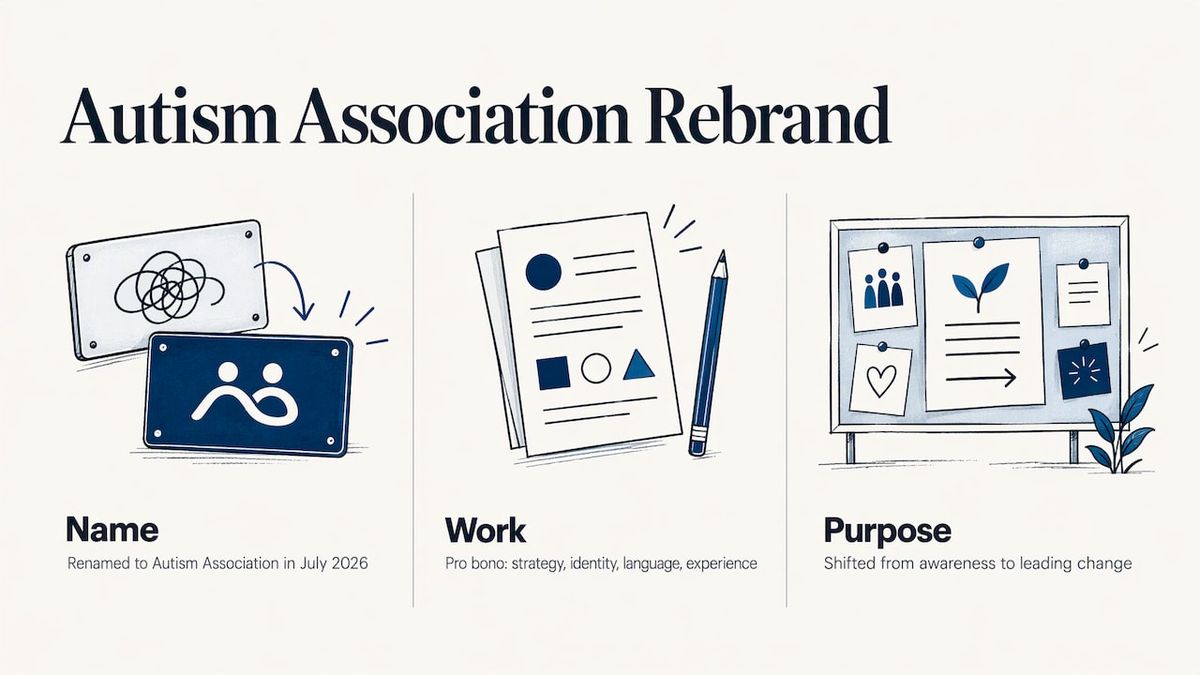
Autism Awareness Australia changed its name to Autism Association of Australia in July 2026. FutureBrand Australia's account says the work was delivered pro bono and covered brand strategy, identity, language and experience, supporting a shift from raising awareness to leading change for the autism community. The organisation's leaders felt they had outgrown awareness as a purpose, so the name needed to signal advocacy and action. The lesson: when the name changes because the mission has moved on, say so directly. The reason is the story.
The examples show that rebrand news works best when a single sentence connects the new identity to a real change in what the organisation does.
Timing and messaging
Shopify Australia's guide says an announcement should explain what is driving the new identity, what is changing and when customers will see it, and that it should go out before the new brand officially launches, not after the reveal. Announcing early gives customers time to adjust and stops them being surprised by a new name on an invoice.
A workable sequence looks like this:
- Before: Finalise the legal change, brief staff and key customers, and prepare assets such as logos, a quote and a short explainer.
- Launch day: Publish the press release, update the website and send the customer email.
- After: Share on social, answer questions and update directories, email signatures, invoices and signage.
Truly Deeply advises that messaging should recognise heritage and equity, emphasise the continuity of core commitments while showing evolution, and that channels such as press releases, social media, email newsletters, website updates and advertising should be chosen together. The press release is one part of that mix, not the whole plan.
If you are planning the wider sequence of before, during and after communications, a release plan covering the lead-up and follow-up is a useful model for staging the messages so they build on each other.
For the content itself, this write-up of why one company redesigned its site again shows how a brand explains a visible change and the thinking behind it. Reading how organisations tell their own story helps you shape yours. For announcements that need to land with the public, how clubs turn announcements into sales is a good look at how organisations share news with their audience.
Adapting the release for startups and nonprofits
Startups
Startups often rebrand early, after finding their market or after raising money. If the change follows a funding round or a pivot, lead with that fact, because it is the news. Our guide to startup press releases covers timing and writing, and the funding announcement guide helps when the rebrand and a raise land together. Keep the story about what customers get from the new direction, not about the logo.
Nonprofits
For a nonprofit, the name often carries the mission. The Autism Association of Australia example shows the approach: explain how the organisation's purpose has grown and what the new name commits it to. Members, donors and the people you serve need reassurance about continuity as much as news about change, so say clearly what stays the same, including your cause, your leadership commitments and how people can still get help.
Agencies handling several clients
If you manage releases for more than one client, keep a checklist of the six questions above for each rebrand, and confirm the legal name and date with each client before drafting. One consistent structure keeps approvals fast.
Getting the release in front of people
Writing the release is half the job. Distribution decides who reads it. Our guides on sending a media release in Australia and press release syndication explain how releases reach journalists and online readers. Once it is live, follow the advice in sharing a press release on social media so your own audience sees it on launch day.
Publish your rebrand announcement with News Today
We built News Today so businesses, agencies, startups and nonprofits can publish news quickly and reach journalists and media outlets across Australia and beyond. You submit your release, it goes through editorial review (instant posting or a 24 to 48 hour review, depending on the case) and it is distributed with SEO-optimised syndication, so the announcement stays discoverable after launch day. You can include media-rich content such as logos and images, choose a category, and receive a media list.
A Single Release costs $39 one-off. Agencies and larger organisations can ask about custom and enterprise solutions. See the pricing page or submit your press release when your rebrand copy is ready.
Final checklist before you publish
- The legal name matches the registered name exactly.
- The first paragraph answers who, what, when, where and why.
- The reason for the change is a business reason, not a design preference.
- The release states what changes and what stays the same.
- A leader's quote adds reasoning, not just enthusiasm.
- Logos and images are attached in high resolution.
- Dates for website, signage and invoices are clear.
- A named media contact is listed with phone and email.
FAQ
Do I need a press release for a new logo?
Usually not on its own. A visual update is typically an owned-channel story, so share it on your website, social accounts and email. A press release makes sense when the logo accompanies a larger change, such as a new name, strategy, market or ownership structure.
What should a company name change announcement include?
Include the old and new names, the date the change takes effect, the reason for the new name and what customers can expect during the transition. Say what stays the same, such as contact details and the team, and add a quote from a senior leader. Confirm the registered name with ASIC first so the release matches.
When should I send a rebrand press release?
Send it before or on the day the new brand launches, not weeks after. Announcing early gives customers time to adjust and stops the new name from arriving unexplained. Prepare your website, email and social updates so they go live at the same time.
How long should a rebranding press release be?
Aim for around one page. The first paragraph should carry the key facts, the middle should explain the reason and the changes, and the end should say what happens next and give a media contact. Link or attach extra material, such as a brand guide or video, rather than adding more text.
What is the difference between a rebrand and a name change?
A rebrand is a broad strategic change to how a company presents itself, which can include its name, visual identity, messaging and positioning. A name change is one possible part of that. A name change also has legal steps for companies, which a visual rebrand does not.