A funding announcement press release tells journalists who raised how much, from whom, and what the money will change. Put those facts in the headline and first paragraph, add one investor quote and one founder quote, explain where the money goes, and issue it only once the deal is signed and any disclosure duties are met. This guide walks through each part, with an Australian lens.
TL;DR
- Lead with the hard news: company, amount, round stage and lead investor, all in the headline and opening paragraph.
- Add background, an investor quote, a founder quote, use of funds and a short company boilerplate. Keep the release to one or two pages.
- Seed rounds need extra clarity on the problem, traction and hiring plans, because the company is often unknown to the reader.
- ASX-listed companies must tell the market first. Nobody in the media hears anything before that.
- Prepare a press kit, set an embargo if you use one, and send the release to the outlets that cover your sector.
Table of Contents
- What a funding announcement must include
- How to structure the release
- Writing the headline and opening paragraph
- Getting the quotes right
- Seed funding press releases
- An Australian example to model
- When to announce, and what disclosure rules apply
- Preparing a press kit
- Distributing the release to Australian media
- Publish your funding announcement with News Today
- A final check before you publish
- FAQ
- Sources
What a funding announcement must include
Journalists scan for a handful of facts. TechCrunch's guide to announcing a round lists the standard components: the news itself (who raised, how much, who invested, who led, what stage), background on the company, validation from investors in the form of a quote, a quote from the founder or CEO, and the company boilerplate.
Here is what each does for the reader.
| Component | What it answers | Where it goes |
|---|---|---|
| Headline | Who raised what, and why it matters | Top of the release |
| Opening paragraph | Company, amount, stage, lead investor, date | First paragraph |
| Investor list | Who led and who participated | Second paragraph |
| Investor quote | Why they backed you | Third paragraph |
| Founder quote | What the money lets you do | After the investor quote |
| Use of funds | Hiring, product, new markets | Middle of the body |
| Company background | What you do and for whom | Body, kept short |
| Boilerplate | Standard "about" paragraph | End of the release |
When several investors take part, the lead investor gets priority and is often the only one quoted, according to the same TechCrunch guide. It also notes that naming investors from earlier rounds signals an ongoing relationship and continued confidence. Both points are easy to apply: quote the lead, then list the rest by name.
If you are wondering how much to say about the company itself, the answer is as little as the story needs. A reporter who has never heard of you wants one clear sentence on what you do and one on why it matters now. Everything else belongs on your website or in the press kit.
How to structure the release
Use the inverted pyramid: the most important information first, the least important last. Startup News points out that most journalists and editors do not read beyond the title and first paragraph before deciding whether to publish, so you have about ten seconds to make your case.
A workable structure, drawn from several investor guides:
- Headline. Company name first, the amount, the round and the one-line reason.
- Subhead. One complementary line.
- Opening paragraph. The full news in a few sentences.
- Investor paragraph. Lead investor, participants, returning backers.
- Investor quote.
- Market and traction paragraph. Why the timing is right.
- Founder quote and use of funds.
- Boilerplate and contact details.
This order closely follows Norwest's funding announcement guide, which runs from headline and subhead to an opening sentence, an investor paragraph, an investor quote and a paragraph on market momentum. The same guide suggests a headline of 70 to 120 characters including spaces, with the company name first, and a subhead of 20 words or fewer.
Length and formatting
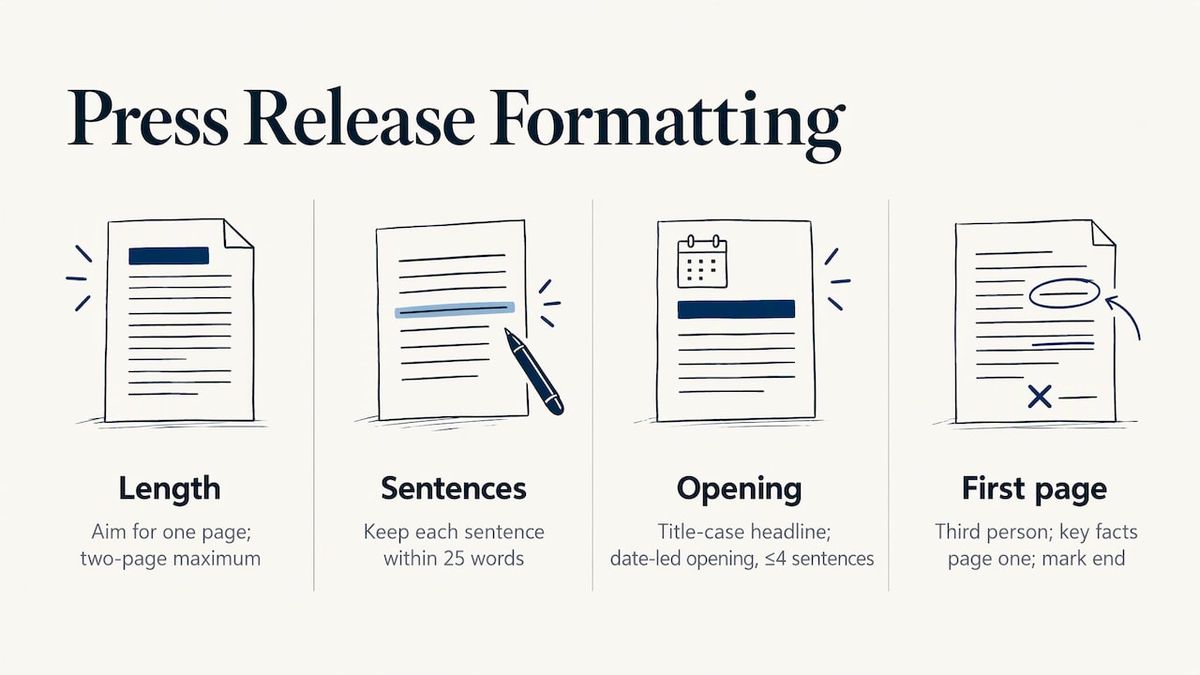
Australian advice on length is consistent: shorter is better. Startup News recommends a release of no more than one page, sentences of no more than 25 words, and a clear end marker. Folklore Ventures' public relations toolkit suggests a headline in title case, an opening paragraph of no more than four sentences starting with the date, and a release of no more than two pages with every key fact on the first. It also recommends third person throughout the body, in the style of a short blog post.
If you want a simple rule: if a journalist could not rewrite your story from the first page alone, the first page is missing something.
Writing the headline and opening paragraph
The headline has one job: carry the news on its own. It will often be copied into an email subject line, a feed or a newsroom inbox without the rest of the release, so it must still be accurate when separated from the body. A good headline is factual, uses an active verb, states the consequence, and avoids exclamation marks and claims you cannot demonstrate. That is the standard set out in My PR Partner's Australian guide to writing a press release.
Folklore's toolkit gives an Australian-style template that shows the pattern: company name, the verb "raises", the amount and round, then the outcome the money pays for.
Here is how that looks for a fictional company:
- Weak: "Exciting news from GreenGrid as we close our latest round!"
- Stronger: "GreenGrid Raises $4 Million Seed Round to Cut Energy Costs for Regional Farms"
The stronger version names the company, the amount, the stage and the benefit, in under 90 characters.
The opening paragraph then expands it. Name the company, the date, the amount, the stage, the lead investor and the single biggest thing the money will do. Leave the history lesson for later. Alpaca VC's founder's guide makes the same point: lead with the hard news, such as funding, a launch, a major partnership or early traction, and keep it prominent throughout, because the release is the raw material a reporter uses to write their own story. Most reporters will not publish it word for word.
Getting the quotes right
Quotes are where a funding release most often goes flat. "We are thrilled to announce" tells nobody anything. Good quotes add judgement, explain consequences or take a clear position. They should never be invented, polished beyond recognition, or approved without the person who is supposedly speaking, as My PR Partner's guidance puts it.
Two quotes do most of the work:
- The investor quote answers "why this company, why now?" It gives the round credibility. It should name something specific, such as the market gap, the team or the traction.
- The founder quote answers "what changes?" It should describe what the funding makes possible, in plain words.
A useful test: remove the speaker's name. If the quote could belong to any company in any sector, rewrite it.
If you can add a third voice, a customer, do. It shows the product is already used, which matters most for early-stage companies.
Seed funding press releases
A seed round is often the first time anyone outside your circle hears of you. That changes what the release must do. Work-Bench's guide to announcing a seed round recommends an inverted pyramid that leads with the company, the amount and the lead and participating investors, then covers the problem, the product, the founding team, customers or growth metrics, use of funds, and quotes from the CEO, the lead investor and a customer.
Alpaca VC's guide turns this into eleven questions your release should answer. In short:
- What is the company, and what makes it different?
- How much was raised, and at what stage?
- Who invested before, and how much has been raised in total?
- Who led and who participated?
- Is anyone joining the board?
- What do the investors and founders say?
- How will the money be used?
- What growth metrics can you share?
- Who are the notable team members, and are you hiring?
- Why does this matter for the industry?
You will not need all eleven in every release. Pick the ones a stranger would ask first.
Use of funds, stated honestly
Readers want specifics: engineers hired, a product module launched, a second state entered. State what you plan to do, not what you promise to achieve. Avoid forecasts of revenue or returns. They add risk and rarely add interest.
Only share numbers you are happy to see quoted. If a metric is confidential, leave it out rather than blurring it. Vague claims such as "rapid growth" give a journalist nothing to write.
An Australian example to model
Listed-company announcements show how plain a good funding statement can be. In April 2022, K2fly's ASX announcement set out that it had raised A$6.2m at A$0.18 per ordinary share through a single-tranche placement. The investors included Maptek, existing institutional investors, key executives and existing sophisticated investors. The funds were earmarked for product development and working capital.
Notice what it does: amount, price, mechanism, who took part and what the money is for, all up front. A private startup's release can be warmer in tone, but it should deliver the same facts in the same order.
For an inspiration on tone, Folklore's toolkit offers a headline in the Australian style that pairs the raise with a market-proof point, such as the share of local retailers already using the product. A proof point like that gives the amount a reason to matter.
When to announce, and what disclosure rules apply
Timing is part of the story, and for some companies it is also a legal matter.
Listed companies
If your company is listed on the ASX, the market comes first. Under ASX Listing Rule 3.1, a listed company must immediately disclose information that a reasonable person would expect to materially affect the price or value of its securities, and the Continuous Disclosure and Communication Policy published by EOS notes the obligation has the force of law under the Corporations Act. The same policy says media must not receive the information before ASX disclosure, even under embargo.
Megaport's disclosure policy says the same in practice: price-sensitive information is not made public until it has been given to the ASX and acknowledged as released to the market, and it must not go to media or analysts earlier.
The stakes are real. In 2021 ASIC reported that the Federal Court found GetSwift and its directors had made misleading statements and breached continuous disclosure obligations in announcements to the ASX during 2017, a period in which the company raised $100 million in capital. If you are listed, have your company secretary or legal adviser clear the release before it goes anywhere.
Private companies and startups
The ASX rules above apply to listed companies. If you are private, your constraints are mostly contractual: your investment documents may say who can announce what, and when. Agree the wording and the date with your investors before anything is published. Norwest's guide advises writing the release three to four weeks ahead of the planned date to leave time for review and approval, and telling no one in the media until the release is officially issued.
A practical sequence:
- Confirm the deal has closed, or that all parties have agreed to a public date.
- Draft the release and circulate it to every named investor.
- Collect written approval of every quote and every figure.
- Choose the day and time. Early in the working week generally gives journalists time to follow up.
- Issue the release and send your targeted pitches at the same moment.
Preparing a press kit
A release works best with supporting material ready. Version One Ventures recommends a press kit with the news story, high-resolution logos and headshots, quotes from investors and customers, and a clear embargo date and time. It is shared with media outlets, reporters and investors so that everyone tells the same story.
Put these in a single folder or page:
- The release as a plain document, not just a PDF
- Logos for your company and each investor, in agreed formats
- Headshots of the founders and the quoted investor
- Two or three product images or screenshots
- A short fact sheet: founding year, location, team size, key metrics you have approved
- A named media contact with a mobile number
A journalist on deadline will use whatever is easiest to find. Make yours the easiest.
Company context also helps reporters get the round right. If your story involves a B2B product, a partner such as outreach and company data enrichment can help you keep your market description and audience details consistent across your announcement and follow-up outreach.
Distributing the release to Australian media
Writing is half the work. The other half is getting the release in front of the right people.
Start with the audience. My PR Partner advises writing for the journalist and their readers rather than for your organisation, then distributing selectively with a short, relevant email pitch. A release that shows impact on a meaningful group of people has a better chance than one that only celebrates the company.
In practice, that means three tiers:
- Your sector's trade and startup press, where a funding round is directly relevant.
- Business and technology reporters at general outlets, who may want an exclusive or an early interview.
- Local and regional outlets, if the money creates jobs or serves a specific community.
Be ready for follow-up. Norwest's guide advises founders to talk specifics in interviews, set boundaries around what they can and cannot discuss, and build relationships, because a reporter who finds you clear and concise in a hot market will call again.
For the mechanics of getting a release live and in front of readers, our guides on how to send a media release in Australia, how to publish a press release online and press release syndication in Australia cover the practical steps. Once it is live, sharing the release on social media extends its reach to investors' and founders' own networks.
Publish your funding announcement with News Today
Once your release is approved and your investors are aligned, News Today lets you publish it quickly. You submit your release, it goes through editorial review, and it is distributed to journalists, media outlets and online readers, with SEO-optimised publication designed to keep it discoverable well after the news cycle moves on. You can include media-rich content such as images, which suits a funding announcement with logos and headshots.
A Single Release costs $39 one-off, and custom and enterprise packages are available for agencies and larger teams on request. See the pricing page for details, or go straight to the submission page when your release is ready.
A final check before you publish
Read the release as a journalist who has never heard of you would, and tick off each item:
- The headline carries the company, amount, stage and benefit.
- The first paragraph could stand alone as a news brief.
- Every figure matches the signed documents.
- Each quote has been approved by the person speaking.
- Every investor named has agreed to the wording and the date.
- If you are listed, the ASX has been told first.
- The boilerplate is current, and the contact details work.
- The press kit is ready to share the moment a reporter asks.
If each line is a yes, send it.
FAQ
How long should a funding press release be?
Aim for one page, and never more than two. Folklore Ventures advises two pages at most with all key information on the first. Put the news in the headline and opening paragraph, and keep the body for quotes, use of funds and background.
Who should be quoted in a funding announcement?
At least the founder or CEO and the lead investor. When several investors take part, the lead is usually the only one quoted, and the others are named in the investor paragraph. A customer quote is a strong third voice, especially for seed rounds.
Do I have to tell the ASX before I announce funding?
If you are an ASX-listed company and the funding is information a reasonable person would expect to materially affect your security's price or value, yes. Disclosure to the ASX must come first, and the media must not hear of it earlier, even under embargo. Speak with your company secretary or legal adviser about the specific raise.
What should a seed funding press release say about use of funds?
Name the concrete things the money pays for: hires, product development, entering new markets. Pair it with the problem you solve, the team and any early customers or growth numbers you are happy to publish. Avoid forecasts.
When should I write the release?
Start three to four weeks before the planned announcement, as Norwest's guide suggests, so that investors can review and approve the wording. Keep the news confidential until the release is officially issued.
Sources
- How to announce a funding round, TechCrunch
- Funding Announcement PR & Media Guide, Norwest
- How To Win Free Media For Your Startup, Part Three, Startup News
- Public relations toolkit, Folklore Ventures
- A Founder's Guide on How to Announce a Funding Round, Alpaca VC
- The Founder's Guide to Announcing a Seed Round, Work-Bench
- How to Write a Press Release: A Guide for Australian Businesses, My PR Partner
- Maptek makes strategic investment in K2fly, ASX announcement
- Continuous Disclosure and Communication Policy, EOS
- Continuous Disclosure Policy, Megaport
- ASIC successful in Federal Court against GetSwift and its directors
- A checklist for your funding announcement, Version One Ventures