A podcast press release is a short, factual announcement that tells journalists, bloggers and newsletter editors why your show is worth a mention. Done well, it is one page that answers who the show is for, what listeners will hear first, where to find it and who to contact. This guide covers the structure, a fill-in template, the materials to attach and how to send it to the right people in Australia.
TL;DR
- Keep it to roughly 300 to 500 words, and lead with the news: what launched, when and where to listen.
- Give journalists a reason to care beyond "we made a podcast": a topic, a trend, a guest, a local angle or a result.
- Include a mobile number, a link to the show, audio, images and a short bio of the host.
- Send it to a small list of people who actually cover your subject, addressed by name, and follow up once after two to three days.
- A beta launch release works differently: explain who can join, how, and what testers get.
Table of Contents
- Why a podcast needs a press release
- What makes a podcast newsworthy
- How to structure a podcast press release
- A podcast press release template
- Supporting material to attach or link
- Finding the right media in Australia
- Sending the release
- Following up and measuring results
- Publish it online as well
- Podcast launch and beta launch press releases
- Common mistakes to avoid
- FAQ
- Sources
Why a podcast needs a press release
The podcast market is crowded, and a new show has no audience, no reviews and no history. A press release gives the media something they can check and quote, and gives search engines a stable, indexable page about your show. Ausha notes that a press release can create buzz and accelerate a podcast's notoriety.
The audience is there to be reached. According to the ACMA's 2024 to 25 report, 52% of Australian adults listened weekly to podcasts or other non-music audio in 2025, and 59% of podcast listeners had used Spotify in the previous seven days to June 2025. That tells you where to point listeners (Spotify first, then the other major apps) and that local journalists have readers who care about audio.
A release is not only for the press. It also works as:
- a reference page you can link from your website, socials and email signature;
- a source for trade and niche newsletters that are always short of content;
- a credibility signal for sponsors, guests and partners who want to see the show is real.
What makes a podcast newsworthy
The fact that a podcast exists is rarely news. The angle is. PodPage observes that the strongest press kits tell a clear story about how the show connects with a cultural or industry trend, so a journalist can immediately see how it serves their own editorial goals.
Try these angles and pick the one that is true for your show:
- A recognisable guest or host. A well-known name, or a respected specialist in a narrow field.
- A local or community hook. A podcast about regional farming, a Western Sydney small business scene or a Tasmanian arts community is of interest to local outlets.
- A gap in coverage. No one else is talking about this topic for Australian listeners.
- Data or original research. A survey, a case study or a finding that the show is built around.
- A cause. A nonprofit launching a series of lived-experience stories, for example.
- A business milestone. A company's first branded show, a partnership, a landmark episode count or a charting position.
If you cannot finish the sentence "This matters now because...", keep working on the angle before you write a word of the release.
How to structure a podcast press release
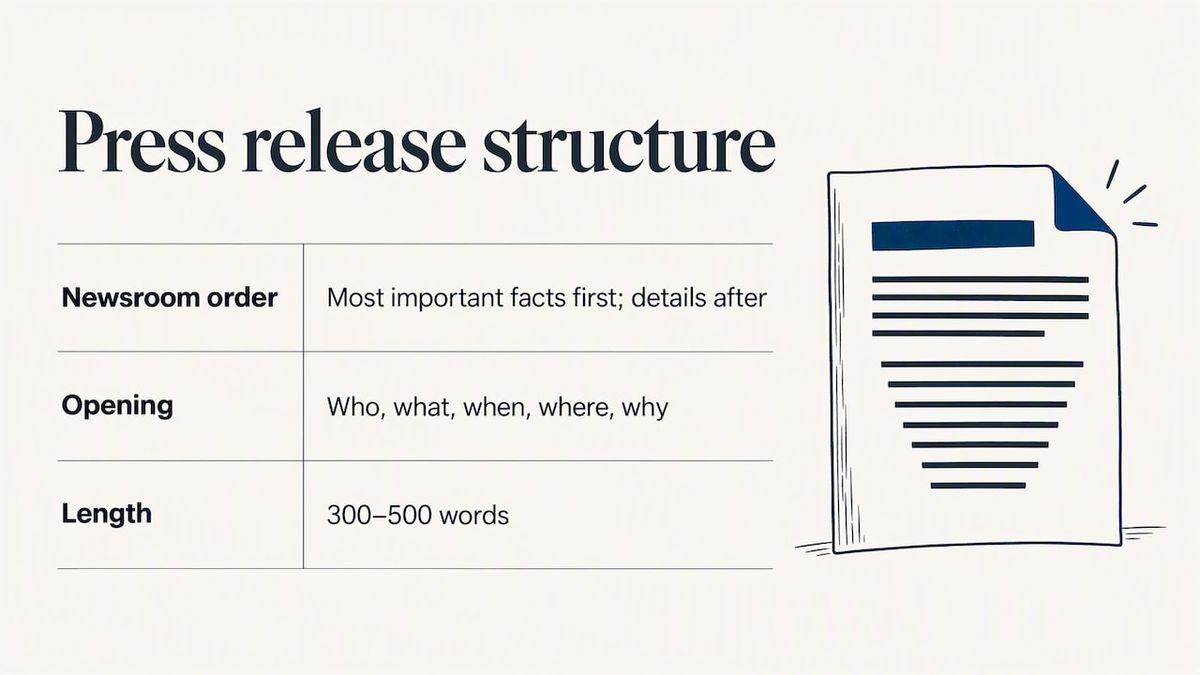
Use the same inverted pyramid a newsroom uses: the most important facts first, supporting detail after. The 5W rule (who, what, when, where, why) is a reliable checklist, and a release of 300 to 500 words is enough to cover it.
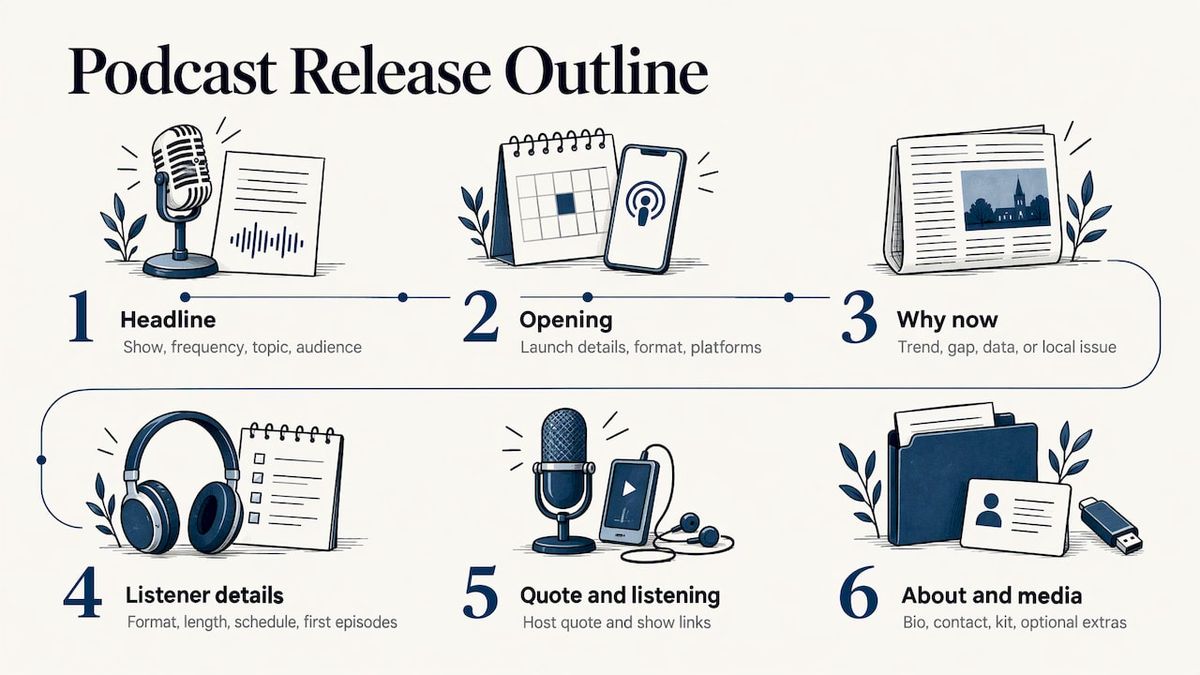
Headline
Be factual and specific. Name the show, the host and the news. A good headline reads like something a news site might run, not an advertisement.
- Weak: "Exciting new podcast changes the conversation!"
- Better: "Brisbane physio launches weekly podcast on injury recovery for amateur runners"
Opening paragraph
One or two sentences with the five Ws: what the show is, who hosts it, the launch date, where it is available, and why it exists. A journalist who reads only this paragraph should be able to write a brief.
Show concept
One short paragraph on the format: episode length, release schedule, whether it is interview-led or solo, and who it is for. Then a paragraph on what listeners will hear first, such as the first three episodes or the first guests.
Quote
One quote from the host or founder that adds a reason or opinion, not a repeat of the facts. Podchaser advises writing in a form that translates easily into a news article and following journalistic conventions such as avoiding first-person language in the body. Put "I" and "we" inside quotation marks only.
Where to listen and how to get it
Link to the show page and to each platform where it is live. List the first episodes by title.
About the host or organisation
Two or three sentences: credentials, track record and relevant experience. Skip the full CV.
Contact details
Include a name, email and a mobile number. My PR Partner stresses that a mobile number should be readily available in the release so journalists can reach you quickly for timely questions or interview requests. If a radio producer calls at 4 pm wanting a guest for the next morning, you want that call.
A podcast press release template
Copy this outline and replace the bracketed parts.
Headline: [Host/Organisation] launches [Show name], a [frequency] podcast on [topic] for [audience]
Opening: [City, State], [date]. [Host name], [role or credential], has launched [Show name], a [format] podcast that [what it does for listeners]. The first episodes are available now on [platforms].
Why now: [One or two sentences on the trend, gap, data or local issue that makes this timely.]
What listeners will hear: [Format, episode length, schedule. Titles or guests of the first three episodes.]
Quote: "[A single, opinionated line from the host about why they made the show]," said [name].
Where to listen: [Links to show page and platforms.]
About [Host/Organisation]: [Two or three sentences.]
Media contact: [Name, role, email, mobile. Link to a folder with audio, images and a media kit.]
The optional extras are a trailer link, a list of confirmed guests and available interview times. Keep all of it factual. If you describe the show as "groundbreaking", a reader can only take your word for it, so show what is different instead.
Supporting material to attach or link
A release gets a journalist interested. The supporting material helps them do something with it. Austech Media recommends preparing media kits with images, spokesperson bios and key facts, and a podcast adds audio to the list.
For radio and podcast coverage, the Nature Media Centre guide says to provide audio, either pre-recorded or live, and notes that some programs also film their shows and share them on YouTube and social media. That is a good reason to have a short audio clip and a video clip ready.
A practical media folder includes:
- the show's cover art in high resolution, and a square and landscape version;
- a headshot of the host and a one-paragraph bio;
- a 30 to 90 second trailer or best-moment audio clip;
- the episode list with short descriptions;
- a one-line description of the show you want repeated;
- links to the show on every platform.
Put it all in one shared folder and link to it from the release. Do not attach large files to cold emails, as they can be blocked or clog an inbox.
Finding the right media in Australia
A small, accurate list beats a large, generic one. My PR Partner's Australian guide recommends researching outlets that cover your subject and building relationships with the relevant reporters, prioritising quality of match over the size of a list. Austech Media puts it this way: databases built from careful reading of journalists' work consistently outperform purchased lists.
For a podcast, aim for these groups:
- Trade and niche publications in your topic (health, farming, finance, education, arts).
- Local and regional media, including community radio and local news sites, where "local host launches show" is a real story.
- Podcast newsletters, review sites and directories that list new shows.
- Radio producers and presenters who book guests, especially if your host is a subject expert.
- Bloggers and newsletter writers who cover the same subject your show does.
To build the list, read the last ten articles each journalist has written and note what they cover and how they prefer to be contacted. If you are growing the same list for other purposes too, this walkthrough of email marketing for musicians shows how to build and use a relevant email audience, and the same principle of relevance over volume applies to media contacts.
Sending the release
Good manners help. Tourism Australia's media guide advises using BCC so journalists' addresses stay private, and addressing the release to a specific person or their title, such as the relevant editor, so it is not missed.
A simple sending routine:
- Write a subject line that says the news: "New podcast: [Show] on [topic], launched [month]".
- Paste the release into the body of the email. Do not make the journalist open an attachment to find out what it is about.
- Add a two-line personal note explaining why you are writing to them specifically.
- Link to your media folder and trailer.
- Send individually or in small groups by beat, not one blast to everyone.
For the mechanics of getting a release out in Australia, see our guide to sending a media release, and for the wider picture of reach, press release syndication in Australia explains how a published release travels to other outlets and readers.
Following up and measuring results
If you hear nothing, Tourism Australia suggests following up within two to three days. Keep it to a short, polite note with a new reason to open: a new guest, a download milestone or an episode relevant to a current news story. One follow-up is enough.
Track what matters to a podcast:
- Coverage: articles, mentions, radio spots and newsletter features.
- Traffic: visits to your show page and to the release from referrals.
- Listens: downloads and new followers in the days after each piece of coverage.
- Quality: are the people covering you the ones you wanted to reach?
Our guide to press release analytics goes through what to track and how to report it. To get more from the release after it is live, sharing a press release on social media covers how to post it so it keeps working.
Publish it online as well
Emailing journalists is only half the job. Publishing the release on a press release platform gives you a permanent, searchable page that you can link from your show notes, your website and your pitch emails. Listeners and journalists who search for your show name later will find it there.
On News Today, a single release is $39 one-off, and you can submit text, images and other media in the same submission. Our team reviews each release for credibility and accuracy before it is distributed, and releases are published to our platform and shared with media networks. Agencies or organisations with ongoing needs can ask about custom and enterprise solutions.
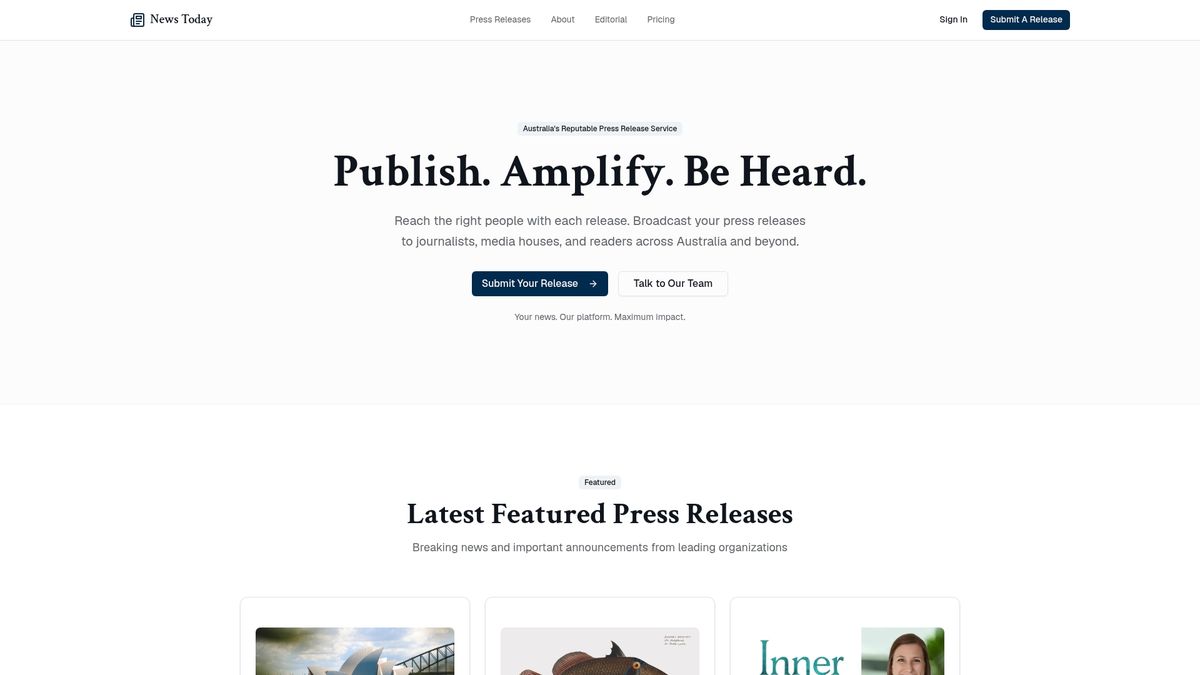
When your release is ready, you can submit your press release or look at the pricing options. If you want to see how the publishing side works first, read how to publish a press release online in Australia.
Podcast launch and beta launch press releases
If you are announcing the launch of a podcast, the structure above applies. Make the release about the arrival of the show, with the first episodes live and a clear call to listen.
A beta launch is different. A beta is a controlled release to a limited audience before public availability, while a full launch releases to everyone at once. Because of this, a beta release is about access rather than availability. Pressfrolic's guide recommends explaining what the product does, any waitlist numbers, the beta timeline, how to join and what testers receive.
In practice, for a podcast, app or product with a limited early release, write:
- What it is: one plain sentence on what the product or show does.
- Who can join: the audience you want, and how many places there are.
- How to join: a link to a sign-up page or waitlist.
- What testers get: early access, a say in the final product, a founding listener role or a discount.
- The timeline: how long the beta runs and when the public version is planned. Use a month, not a vague "soon".
- Proof of demand: waitlist numbers only if they are real and you can stand behind them.
If your launch involves software, our guide to a press release for an app launch covers the same ground in more depth. If your podcast is part of a school, university or training program, the education press release guide will help you frame it. If the show has won something, an award press release is the one to write next.
Common mistakes to avoid
- Burying the news. If the show name and where to listen are in paragraph four, rewrite it.
- Writing an advertisement. Adjectives are not facts. Replace "amazing" with a specific detail.
- Sending to everyone. Fewer, better matched contacts get more replies.
- No audio. A journalist cannot cover a podcast they cannot hear in 30 seconds.
- No mobile number. You lose the quick-turnaround requests.
- Overlong releases. If it runs past one page, cut the background.
- Errors in the published version. If something is wrong, see how to handle a press release correction quickly.
FAQ
How long should a podcast press release be?
About 300 to 500 words, according to Ausha. That is enough for the five Ws, one quote, a short bio and contact details. Put longer material, such as episode lists and bios, in a linked media folder.
When should I send it?
Send it when the first episodes are live so journalists can listen straight away, or a day or two before launch if you give them early access to the audio. Avoid sending it before there is anything to hear. If you are running a beta, send it when sign-ups open.
Who should receive a podcast press release?
Send it to journalists, producers and newsletter writers who have recently covered your topic, not to a bulk list. Address each one by name or title and use BCC if you send to a group. Local media and niche publications are often the best starting point.
Is a podcast press release different from a press kit?
Yes. The release is the one-page announcement. The press kit is the supporting folder with images, a host bio, a trailer, episode details and links. Send the release in the email body and link to the kit.
Sources
- Podcast Press Release & Launch Plan (Ausha)
- Communications and media in Australia: trends in viewing and listening 2024 to 25 (ACMA)
- How to Build a Podcast Press Kit (PodPage)
- The Ultimate Guide to Podcast Press Releases (Podchaser)
- How to Write a Press Release: A Guide for Australian Businesses (My PR Partner)
- How to contact media and write a media release (Nature Media Centre)
- The Media Coverage Playbook (Austech Media)
- Working with the Media Guide (Tourism Australia)
- Beta Launch Press Releases for SaaS Startups Guide (Pressfrolic)
- Beta Launch vs Full Launch (StartupLaunchStrategy)