
You can publish a press release online in three ways: post it on your own website, send it directly to journalists, or submit it to a distribution platform that publishes it and puts it in front of media and readers. Most Australian businesses end up using all three, in that order of effort. This guide covers each route, how to prepare a release that is worth publishing, what the rules say about contacting journalists, and how to tell whether it worked.
TL;DR
- Publishing online means making the release findable (on your site and a distribution platform) and putting it in front of the right journalists. Coverage is never guaranteed.
- Write a short release with a clear lead, an approved quote and full contact details. Aim for about one page.
- Publishing on your own site is free but reaches almost nobody on its own. A platform adds a searchable, credible home and a media audience.
- Cold emailing journalists in bulk can fall foul of the Spam Act 2003. Keep consent records and an unsubscribe option.
- At News Today, a single release is $39 one-off, published through our submission page.
Table of Contents
- What it means to publish a press release online
- Prepare the release before you publish anything
- Where to publish a press release
- Choosing between self-publishing and a service
- The rules on contacting journalists
- What publishing costs
- Publish with News Today
- A step-by-step plan to publish
- How to tell whether it worked
- Common mistakes to avoid
- When your release should not be a press release
- FAQ
- Sources
What it means to publish a press release online
A press release is a short document announcing something newsworthy: a launch, an appointment, a result, an event, a partnership. The Fisheries Research and Development Corporation describes a media release as something designed to attract media attention and win media coverage. That purpose shapes everything else: the release is written for journalists first and customers second.
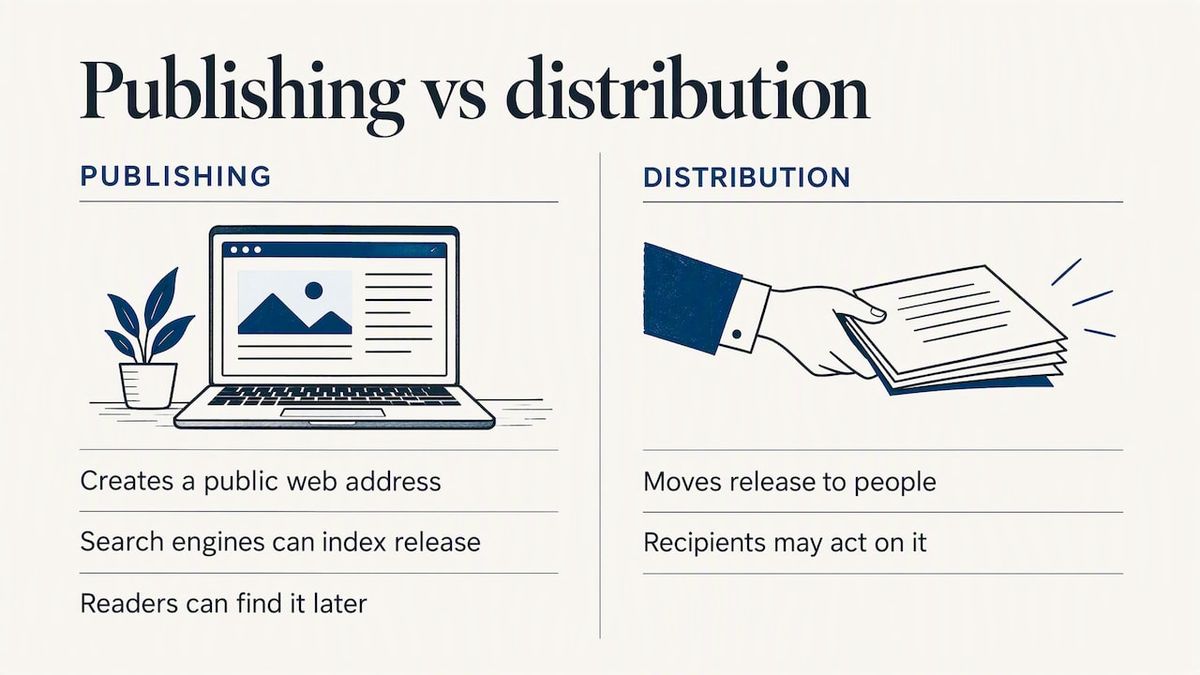
Publishing it online adds a second job. A release on the web is also a page that search engines can index, that readers can find months later and that other writers can quote or link to. So an online release has two audiences: the journalist deciding whether there is a story, and the person searching for your name or topic next year.
That is why "publish" and "distribute" are not the same thing. Publishing puts the release at a public address. Distribution moves it to people who might act on it. A good plan covers both.
Prepare the release before you publish anything
Most releases that go nowhere fail before they are sent. The news is thin, the lead is buried or the contact person does not pick up the phone. Fix these first.
Get approval and check the news value
The FRDC guide says to secure the necessary authority and approvals before a release goes out, and to make sure the people quoted and the media contacts will actually be available once it is live. Nothing damages a launch like a journalist ringing the listed contact and reaching voicemail for a week.
Then ask the plain question: who outside your business would care? A new product with a real difference, a funding round, a local event, a research result or an award is news. A new logo or a minor website update usually is not. If the answer is "only us", publish it as a blog post instead.
Structure it the way editors expect
Museums and Galleries NSW sets out a standard layout for a press release that works for any organisation:
- Your organisation name and the release date.
- "FOR IMMEDIATE RELEASE", or an embargo time if the news must not run before a set moment.
- A concise headline.
- A first paragraph that covers what, where, when, why, how and who.
- Body copy that expands on the detail.
- An approved quote.
- Background on your organisation.
- "ENDS" to mark the finish.
- Complete media contact details: name, phone, email.
The FRDC guide adds the style rules: a clear lead holding the key messages, simple language, attributed quotes and, generally, a length of about one page. Write for a busy reader who will decide in ten seconds.
A quick example
Weak headline: "Greenfield Plumbing Is Excited to Announce Its New Service".
Stronger headline: "Geelong Plumber Launches Same-Day Hot Water Replacement for Homeowners".
The second names a place, a person type and a benefit. The first lead could then read: "Greenfield Plumbing has launched a same-day hot water replacement service across Geelong and the Surf Coast, aimed at households left without hot water." Everything a journalist needs to judge the story sits in that one sentence. (The business in this example is invented for illustration.)
Add media that helps
A photo, a logo and a short video clip make a release easier to run. Supply them in a format a journalist can use without asking, and name the file clearly. Our platform accepts media-rich submissions, so images and links can travel with the text.
Where to publish a press release
There are four realistic places for an Australian business. They are not exclusive.
| Route | What you get | Cost | Main limit |
|---|---|---|---|
| Your own website newsroom | A permanent, indexable page you control | Free (your time) | Only people who already know you will find it |
| Direct email to journalists | A personal pitch to the right reporter | Free (your time) | Needs a good contact list and care with the rules on consent |
| A press release distribution platform | A published, searchable release plus syndication and media reach | Per release or bundle | You still need newsworthy content |
| Paid announcement on a trade or business site | Placement on one publisher's site and mailing list | Set by that publisher | One audience, one site |
Your own website
The Science and Technology Australia guide to distributing a media release treats self-publishing as posting a copy on your website after emailing the release, then sharing the link on social media. That is sound as a baseline. Give each release its own page, a clear date, the full text and the contact details. It builds an archive journalists can check when they research you.
Its weakness is reach. A page on a small business site rarely ranks for anything beyond your own name.
Directly to journalists
The FRDC guide says to decide first whether you are aiming at local or national print, radio or television, then build a targeted outlet list. It also cautions that coverage is not guaranteed. A regional bakery should target the local paper and community radio, not a national business desk. Choose by format and location, and send each journalist something relevant to their round.
Our guide on how to send a media release in Australia goes through the email itself: subject line, what to paste in the body and when to follow up.
A distribution platform
A platform gives your release a public, search-friendly page and then pushes it outward. The FRDC guide notes that a paid provider can help with a targeted list, and the STA guide says a distribution service can help with distribution lists while being clear that coverage is still not assured. Both are the honest framing: a platform improves your odds and your visibility. It does not buy a story.
If you want the detail of how a release is picked up and republished across outlets, see our practical guide to press release syndication in Australia.
Paid announcements on a single publisher's site
Some Australian trade and business publishers sell announcement slots that publish your release on their own site. These can suit a niche audience, but you pay for one outlet and one readership. They work as an addition, not a replacement, for wider distribution.
Choosing between self-publishing and a service
Use this as a rough decision guide.
- Self-publish and email directly if you have a strong relationship with two or three journalists, your news is local and you have time to chase.
- Use a platform if you have no media list, you need the release to be found by search for a long time, or you are announcing for several clients and need a repeatable process.
- Use both for anything important. Post it on your own site, publish it through a platform, then pitch the two journalists most likely to care with a personal note and a link.
The effort comparison matters. Building and cleaning a media list takes hours, and every outbound email adds legal responsibility, covered next.
The rules on contacting journalists
This part is easy to miss. Emailing a release to a long list of people can count as a commercial electronic message. Under Australia's Spam Act 2003, the Australian Communications and Media Authority says such messages must have the recipient's consent, identify the sender clearly and include a working unsubscribe option. The unsubscribe has to be free and be processed within five working days.
The same ACMA page explains that consent can be express or inferred, and that collecting contact details for a different purpose, such as a paperless receipt, does not create inferred consent. Whether a given pitch to a journalist counts as a commercial message depends on the facts, so if you plan large-scale outreach, get advice from a lawyer who knows the Act.
In practice:
- Send a targeted pitch to a reporter whose published work covers your topic, rather than blasting a purchased list.
- Put your business name and contact details in every message.
- Include a plain way to opt out.
- Keep a record of where each address came from and when. ACMA's enforcement reporting stresses that businesses need clear, provable records of when and how consent was obtained, whichever third-party list provider they use.
Publishing through a platform that delivers to its own media network takes much of this off your plate, though you remain responsible for what you send yourself.
What publishing costs
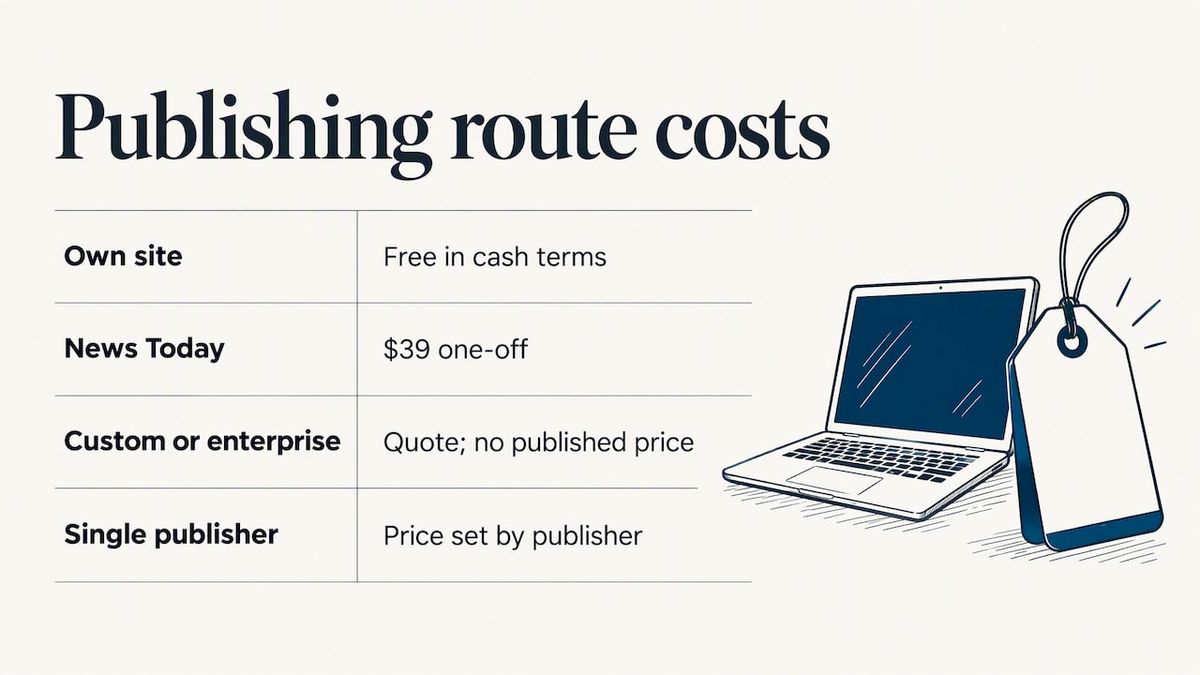
Costs vary widely by route. Your own site is free in cash terms. Platforms usually charge per release or sell bundles, and single-publisher announcements are priced by that publisher.
At News Today, a single release is $39 one-off. Custom and enterprise solutions for larger or ongoing needs are also listed on the pricing page, with no published price, so you would ask us for a quote. Premium users also get analytics on engagement.
When you compare providers, check what the fee actually includes: whether there is editorial review, how fast the release goes live, whether images are supported, whether you get a permanent public page and what reporting you receive afterwards.
Publish with News Today
News Today publishes press releases for Australian businesses, PR agencies, startups and nonprofits. You submit your release, it goes through editorial review (instant or within 24 to 48 hours, depending on the case), and it is published on a search-optimised page and distributed to journalists and media outlets across Australia and beyond. You can choose a category so the release reaches the right desks.
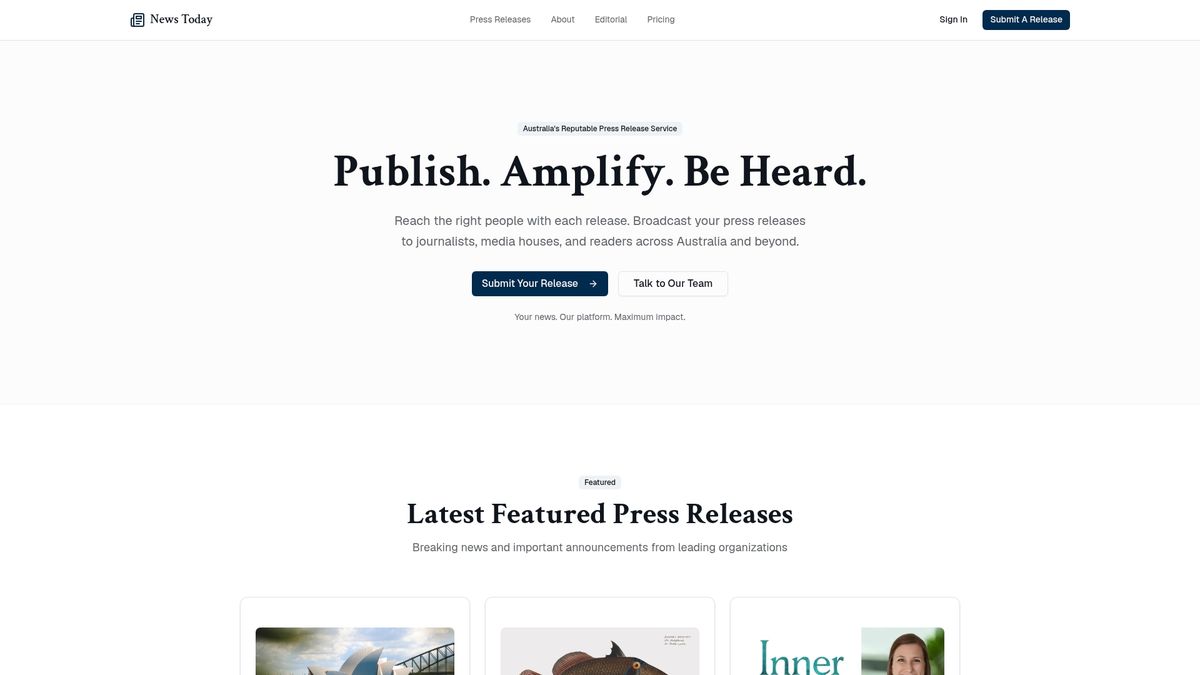
A single release costs $39. If your release is ready, submit it here. If you handle many clients or announce often, see the pricing page for custom and enterprise options. You can also look at a published release on our site to see how a finished page looks, and read about our editorial standards.
A step-by-step plan to publish
- Confirm the news. Write one sentence stating what has changed and who it matters to. If you cannot, wait.
- Get sign-off. Approve the quotes and facts with everyone named, and confirm that your contact is reachable.
- Write one page. Use the layout above. Lead with the news, keep sentences short and attribute every quote.
- Prepare assets. Photo, logo and any link you want readers to follow.
- Publish on a platform. Submit the release, choose the category and wait for review.
- Post it on your own site. Give it a dated page and add the platform link, or the other way round.
- Pitch two or three journalists personally. Short email, link to the release, offer the quoted person for interview.
- Follow up by phone or message once. The STA guide recommends a phone follow-up after the email, and notes that coverage can still not follow.
- Share it. Post the link on your social channels and send it to your own customer list, where you already have their consent.
- Review the results after a week and again after a month.
Specific types of release have their own angles. If you are announcing software, see our guide to a press release for an app launch. For schools and universities, the education press release guide covers the details.
How to tell whether it worked
Publishing is not the finish. Decide before you send what success looks like, otherwise you will count whatever happened.
A media coverage playbook published by an Australian agency in 2026 suggests setting a baseline before outreach, such as share of coverage or branded search volume, then measuring outcomes like changes in behaviour rather than relying on advertising value equivalence. That fits the practical advice below.
- Pickups: which outlets published or quoted it, and whether they linked to you.
- Traffic: visits to the release page and to the page it points to, compared with a normal week.
- Actions: enquiries, sign-ups, calls or sales that followed, ideally asked about directly ("how did you hear of us?").
- Search: whether your name or the topic now surfaces the release.
- Gaps: outlets you expected to run it that did not, and any errors in what was published.
A short weekly note covering those five points is enough to improve the next release. Our guide to earned media metrics explains what to track and how to report it, and monitoring brand mentions shows how to catch coverage you did not know about.
If you spot a mistake after publishing, act quickly. Our guide to a press release correction walks through how to fix an error and tell the people who already have the original.
Common mistakes to avoid
- Treating the release as an advertisement. Journalists want a story with facts, not slogans. Remove "world-class" and "innovative" unless you can prove them.
- Burying the lead. If the news appears in paragraph four, most readers never get there.
- Quoting nobody, or quoting someone unreachable. Every quote should be from an approved person who can take a call.
- Sending the same email to everyone. Relevance to the outlet's format and location is the single biggest lever the FRDC guide points to.
- Sending once and stopping. One follow-up is reasonable. Five is not.
- Publishing and never measuring. Without a baseline you cannot tell which release worked.
- Promising results. Never tell your boss or client that a release will lead to coverage. It improves your chances; it does not guarantee them.
When your release should not be a press release
Some news belongs elsewhere. A routine price change, a small hours update or a seasonal sale is better as a website notice and a social post. Save press releases for the announcements you would be happy to see quoted in a newspaper, because every release you publish also builds the public record of your business. A tidy archive of genuine news is worth more than a stream of minor updates.
Nonprofits and startups, in particular, benefit from picking one or two real stories a quarter: a funding result, a milestone, a report, a partnership with a known name. Pair each with a human angle, such as a named person affected, and a number that is easy to repeat.
FAQ
Can I publish a press release for free?
Yes. You can post it on your own website and share the link on social media, and you can email it to journalists yourself. The trade-off is reach: a page on your own site is seen mostly by people who already know you, and you carry the time and legal care of outreach. A paid platform adds a public, searchable home and distribution.
Where should I publish a press release in Australia?
Start with your own website newsroom, then add a distribution platform so the release is searchable and delivered to media. Pitch a few journalists personally. Local news targets suit local outlets; national news suits national desks. Match the outlet to your topic and location.
How long should a press release be?
Generally about one page. The FRDC guide recommends that length, with a clear lead, simple language and attributed quotes. Put the most important facts in the first paragraph and keep background to a short closing section.
Will publishing guarantee media coverage?
No. Both the FRDC and STA guides are clear that coverage is not guaranteed, whether you send it yourself or use a service. Publishing improves visibility and gives journalists an easy source to find. Coverage depends on whether the story is relevant and interesting to them.
How much does it cost to publish a press release with News Today?
A single release is $39 one-off. Custom and enterprise solutions are available for agencies and frequent publishers, and you can ask about them through the pricing page.
Sources
- Guide to writing a media release, FRDC, May 2024
- Writing a press release, Museums and Galleries of NSW, September 2024
- How to distribute a media release, Science and Technology Australia
- Avoid sending spam, ACMA
- Action on scams, spam and telemarketing: July to September 2023, ACMA