
A good press release quote gives an opinion, a reason or a consequence in a real person's voice, and it does not repeat facts the release already states. Attribute it with "said", give the speaker's full name and title on first mention, and make sure that person can take a call from a journalist. Most releases need one to three quotes. This guide covers how to write them, how to format them for Australian readers, and how to fix the most common problems.
TL;DR
- A quote earns its place by adding something the body text can't: a judgement, a reason, a consequence or a human reaction.
- Format it simply: the quote, then "said", then the speaker's full name and title on first reference, and the surname alone afterwards.
- Draft from a real conversation, then get the speaker's approval. Words they would never say aloud are the first thing a journalist notices.
- Use one to three quotes. More only helps when each speaker brings a different angle.
- Put the quote after the opening paragraph has covered who, what, where, when, why and how.
Table of Contents
- What a press release quote is actually for
- The four parts of a quote that gets used
- Where a quote sits in the release
- How to format and attribute quotes
- How to write a quote that sounds like a person
- Before and after: rewriting weak quotes
- How many quotes should a press release include?
- Who should you quote, and why variety matters
- Getting the quote in front of journalists
- Choosing a distribution service when you compare options
- Publish your release with News Today
- A final pass before you send
- FAQ
- Sources
What a press release quote is actually for
Facts tell a journalist what happened. A quote tells them what it means. Australian guidance for media releases makes the same point from different directions: the Fisheries Research and Development Corporation's guide says quotes can make a release more interesting and that journalists look for a quote or sound bite. Museums Galleries NSW recommends adding a quote from a key stakeholder and using facts and figures to add weight.
The difference between a quote that gets lifted into a story and one that gets deleted is usually this. A useful quote provides an opinion, judgement, reason or consequence in a real voice, rather than restating facts already in the body text. A weak quote is a paragraph of the release wearing quotation marks.
Two tests are worth applying to every quote before you send it:
- Remove it. If the release loses nothing, the quote is decoration.
- Say it aloud. If the named person would never say it in a meeting, a lift or a phone call, rewrite it.
The four parts of a quote that gets used
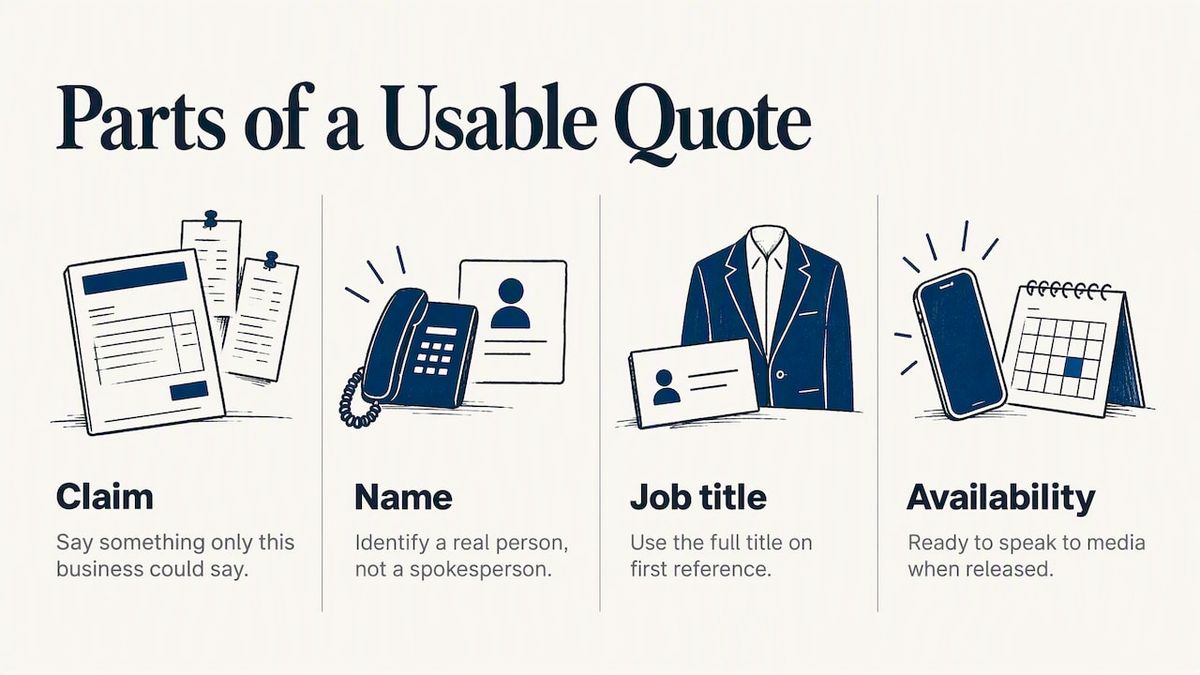
Think of a usable quote as four parts working together.
A specific claim. Something only this business could say. "We're thrilled to announce" could be said by anyone about anything. "Half of our customers told us they were still posting invoices, so we built the tool around that" could only come from one company.
A real person's name. Not "a spokesperson" and not the company name. Journalists want someone they can ring.
A job title. The title tells the reader why this person has standing to say it. Use the full title on first reference.
Availability. The FRDC guide says the person quoted should be available to speak to the media when the release goes out. A brilliant quote from someone on leave is a missed opportunity, because the journalist's next step is to ask a follow-up question.
Where a quote sits in the release
Quotes come after the structure is in place, not before. The first paragraph should cover what, where, when, why, how and who was involved, with the main points before a quote from a key stakeholder. Science & Technology Australia's media-release guide goes further and suggests adding quotes once the structure and context are established, so the spokesperson can add emphasis, useful detail or emotion rather than carrying the basic facts.
A workable skeleton looks like this:
| Position | What goes there |
|---|---|
| Headline and first paragraph | The news, with who, what, where, when, why and how |
| Second paragraph | The key detail or figure that supports the news |
| Third paragraph | First quote: the reason or the "so what" |
| Middle | Background, numbers, how it works |
| Later paragraph | Second quote from a different voice, if you have one |
| End | About the organisation, contact details |
The first quote works best in the first third of the release. Journalists skim, and the best sound bite should not be buried under the boilerplate.
How to format and attribute quotes
Attribution
Keep it plain. Current guidance for release writers is to start the paragraph with the quote, use "said" as the verb (not "stated", "commented" or "added"), and give the full name and title on first reference. After that, use the surname only, and keep the title in lower case when it comes after the name.
First reference:
"Most of our customers had never used an online booking tool before, so we kept the first screen to a single button," said Priya Nair, chief executive of Harbour Bakehouse.
Later reference:
"We're opening two more sites by March," Nair said.
Attribute every quote to a person or organisation. The FRDC guide asks for full titles and attribution on every quote, and it also advises writing the release in the third person with simple language.
Single or double quotation marks?
This is the one place where Australian readers can be tripped up by overseas guides, which nearly all use double quotation marks. Australia's Government Style Manual uses single quotation marks for standard quotations and keeps double marks for a quotation inside a quotation. Many commercial and media outlets in Australia also use single marks in print, while a lot of web content uses double.
The practical rule is to pick one convention for the whole release and apply it consistently. If your organisation follows the Style Manual, use single marks. If your house style or your audience is international, double marks are fine. Never mix the two in one document except for a quote inside a quote.
Long quotes
The Style Manual says quotations longer than about 30 words are usually set as indented block quotations without quotation marks. For several paragraphs of uninterrupted speech in a media release, it recommends an opening quotation mark at the start of each paragraph and a closing mark only at the end of the final paragraph. In practice, a quote that runs that long is a sign it needs trimming. Two sentences is a good ceiling.
Quick formatting checklist
- The quote opens the paragraph, then the attribution follows.
- "Said" is the verb, placed after the first sentence if the quote has two.
- Full name and title on first mention, surname after that.
- One speaker per paragraph.
- Consistent quotation marks throughout.
- Punctuation inside the closing mark when the quote is a full sentence.
How to write a quote that sounds like a person
Start from a conversation
Draft quotes from an actual interview or specific input from the speaker so they keep their own voice, then have them approve the text. Even a five-minute call is enough. Ask three questions:
- Why does this matter to your customers right now?
- What surprised you while you were building or planning it?
- What will be different a year from now?
Pick the answer that sounds most like a human being, trim it, and send it back for sign-off. The process matters. Quotes are drafted for the speaker and then approved by them, and that approval is what makes the words theirs. Museums Galleries NSW also advises getting the stakeholder's approval before the release goes to media, and Science & Technology Australia recommends the spokesperson read the drafted quotes in the context of the full release.
Write at least one soundbite
Aim for conversational language, avoid corporate jargon, and make sure at least one sentence can stand alone as a soundbite that a journalist can lift into their story. That sentence should make sense with no surrounding context. It should be short enough for a radio grab or a social caption.
Give it a job
Every quote should do one of these:
- Explain the why: the reason the company made this decision.
- Show the impact: what changes for a customer, patient, student or community.
- Offer a view: an opinion about the industry or the problem.
- Look ahead: what comes next.
If a quote does none of these, cut it.
Before and after: rewriting weak quotes
These examples are illustrative, not real people or companies.
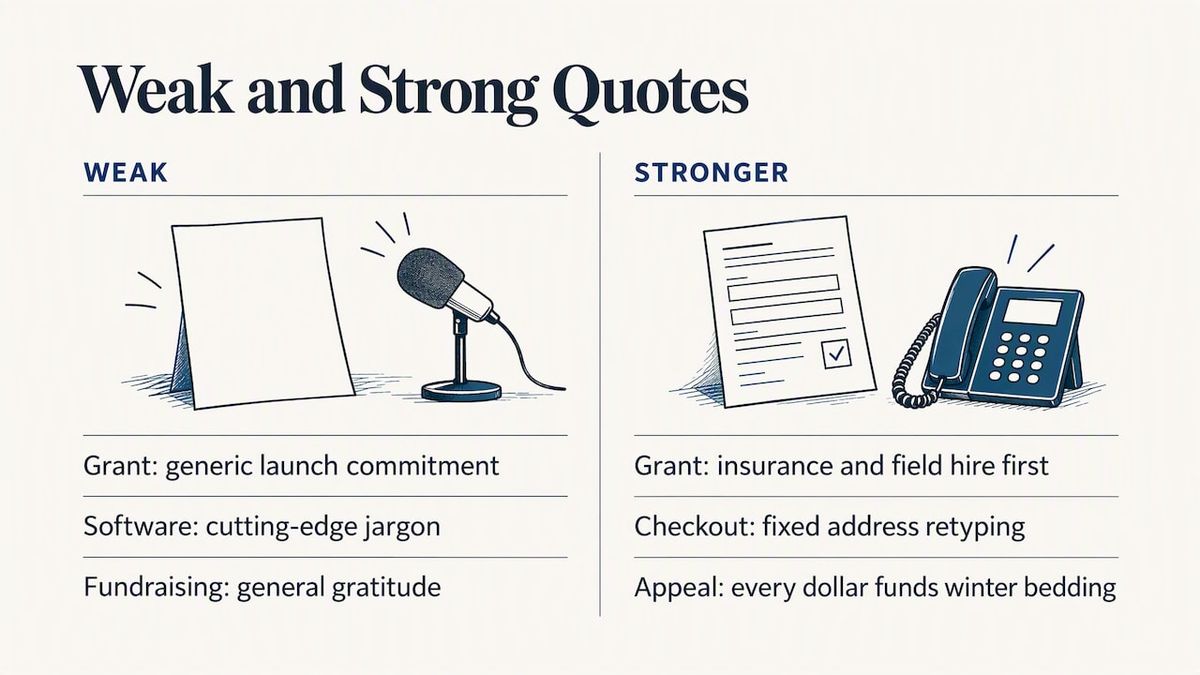
Announcement of a new community grant program
Weak:
"We are delighted to launch this exciting initiative, which demonstrates our commitment to the community," said the spokesperson.
Stronger:
"Small clubs here spend most of their budget on insurance and field hire, so the grant covers those first," said Mei Tran, community programs manager at Riverbend Council. "If a netball club can stop running sausage sizzles just to pay the power bill, that changes their year."
What changed: a named person with a title, a specific problem, a concrete picture, and a closing line a journalist can lift.
A software update
Weak:
"This release leverages cutting-edge technology to deliver best-in-class solutions," said Tom Walsh.
Stronger:
"People kept asking us to stop making them retype their address at checkout, so we fixed that," said Tom Walsh, product lead at Tallyman Software. "It sounds small. It cut abandoned carts in our own shop."
Only use a result like that if it is true and you can back it up. Never invent a figure to make a quote punchier.
A nonprofit announcing a fundraising result
Weak:
"We are so grateful to everyone who supported us," said the director.
Stronger:
"Every dollar from this appeal goes to winter bedding for families already on our waiting list," said Aisha Karim, executive director of Northside Family Support. "Those families are on the list because we couldn't help them last year."
Common mistakes
- Jargon and superlatives. "World-class", "innovative", "synergy" and "solutions" tell a reader nothing.
- Repeating the lead. If the quote restates the headline, cut it.
- Anonymous quotes. "A spokesperson said" gives a journalist no one to call.
- Scripts nobody approved. An executive who sees their own quote for the first time in the published release will not be happy, and nor will the journalist who rings them.
- Too many speakers. Five quotes from five internal people reads like a staff meeting.
- Quotes that carry the facts. Dates, prices and product specs belong in the body, not in somebody's mouth.
How many quotes should a press release include?
One to three works for most releases. A single, strong quote from the most relevant senior person is enough for a routine announcement. Add a second voice when it brings a different angle: a partner, a customer, a researcher, a local councillor. Beyond three, the release starts to feel padded and the strongest line loses its force.
A useful rule: each speaker should be quoted for a different reason. The chief executive explains the decision, the customer describes the impact, and the expert puts it in context. If two speakers say much the same thing, keep the better one.
Who should you quote, and why variety matters
Choose the person closest to the substance of the news rather than the most senior. A founder is right for a funding round. The head of engineering is right for a technical change. A programme participant is right for a community story.
It is also worth thinking about whose voices get heard. A Lowy Institute study of foreign affairs reporting found journalists profiled men's opinions rather than women's seven times out of ten, with male journalists more likely to quote men and women journalists more likely to quote women. That is one field, but the lesson carries over: if your organisation has several qualified spokespeople, offering a range of voices gives journalists more to work with and gives your release a better chance of fitting the story they are building.
Getting the quote in front of journalists
A great quote only works if the release reaches the people who need it. If you are distributing through a service, make sure the headline and the first paragraph carry the news, because the quote will rarely be what gets a release noticed. For the mechanics of getting a release in front of Australian media, our guide to sending a media release in Australia walks through the process, and press release syndication explains how wider distribution works.
One reason syndication matters here: research on Australian newsrooms found that wire copy is treated as credible because it is assumed to have been verified, which leads to it being passed on quickly. That research is from 2011 and concerns news agencies, but it shows why accuracy and clear attribution carry such weight. A quote with a real name and title is easier for a busy desk to trust.
After you send it, be reachable. A Mumbrella commenter in 2019 advised PRs to pick up the phone at the start of a journalist's shift rather than hide behind email. The point holds: the person you quoted should know the release is out and be ready to take the call.
Choosing a distribution service when you compare options
If you are weighing up services, including overseas free-listing sites, look at what matters for a release with strong quotes:
- Editorial review. Does someone check the release for accuracy and credibility before it goes live?
- Australian focus. Does the service reach Australian outlets and readers, or mainly an overseas audience?
- Search visibility. Will the release stay findable, with its quotes intact and indexable, long after the day it publishes?
- Media-rich submissions. Can you add images, logos and speaker photos beside the quotes?
- Clear pricing. Do you know the cost before you submit?
- Reporting. Can you see how the release performed? Our guide to press release analytics covers what to track.
A quote that is well formatted and attributed is the same on any platform. What changes is who sees it and how quickly.
Publish your release with News Today
Once your quotes are approved and the release reads cleanly, you can publish it through News Today. We offer instant publication and an editorial review, and our own claim is a 24 to 48 hour review turnaround. We distribute across Australia and to international outlets, with SEO-optimised pages designed for long-term discoverability. A single release costs $39 one-off, and custom and enterprise packages are available on request. See the pricing page for details.
When you are ready, submit your press release. If you want to see how finished releases look, browse our editorial page for published examples. And if a figure or name changes after you publish, our guide to correcting a press release explains the steps.
A final pass before you send
Run through this list for each quote:
- Is it spoken by a named person with a full title?
- Has that person read and approved the exact wording?
- Does it say something the body text doesn't?
- Does at least one sentence work alone as a soundbite?
- Is attribution "said", with surname only after first mention?
- Are the quotation marks consistent with your chosen style?
- Is the speaker available to journalists today and tomorrow?
- Have you removed jargon, superlatives and invented statistics?
Then share it beyond the wire. A strong quote also makes a good social post, and our guide to sharing a press release on social media shows how to do it well.
FAQ
How many quotes should a press release have?
One to three is the usual range. One strong quote from the most relevant person suits a simple announcement. Add a second or third only when each speaker offers a different angle, such as a customer or partner alongside the executive.
What is the correct format for a quote in a press release?
Start the paragraph with the quote, follow with "said", and give the speaker's full name and title on first reference. Use the surname alone afterwards. In Australia, the Government Style Manual uses single quotation marks, but whichever style you choose, keep it consistent through the release.
Can I write the quote myself?
Yes, writers commonly draft quotes, but the speaker must approve the final wording before the release goes out. Base the draft on a real conversation so it sounds like them, and make sure they are available if a journalist calls.
Where should the first quote go?
After the opening paragraph has covered who, what, where, when, why and how. The first quote usually sits in the second or third paragraph, where it can add the reason or the impact behind the news.
What makes a quote useful to a journalist?
It contains an opinion, reason or consequence the body text doesn't, comes from a named person with a title, and includes at least one short line that can be lifted straight into a story.
Sources
- Quotation marks, Style Manual (Australian Government)
- Guide to writing a media release, Fisheries Research and Development Corporation
- Writing a press release, Museums Galleries NSW
- Media release, Science & Technology Australia
- Quote rules, Newsprint
- Study exposes gender gap in foreign affairs reporting, Lowy Institute
- The Silent Partner: News Agencies and 21st Century News, ResearchGate
- PRs, you're failing to adapt to the digital news cycle, Mumbrella