
A startup press release is a short, factual announcement of something newsworthy, such as a launch, a funding round, a key hire or an award, written so a journalist can judge it in seconds. It works when the news is real, the hook is clear and it reaches the right people. It does not work as a calendar habit or as a substitute for pitching. This guide covers when to issue one, how to build it, how to handle launch and funding news, and how to get it in front of Australian media.
TL;DR
- Send a release only when you have genuine news: a launch, funding, a major hire, an award or a significant new feature.
- Lead with who, what, when, where and why in the first paragraph, then add a quote, background and a contact point. Keep it to about one page.
- Treat the release as the record of the news. Pitching journalists is what earns coverage, and coverage is never guaranteed.
- Prepare your media list, media kit and spokesperson before the announcement date, and avoid weekends and crowded news days.
- Give Australian journalists an Australian angle, then distribute through a service that publishes instantly and reaches media outlets.
Table of Contents
- When a startup should issue a press release
- Where the press release fits in your startup PR strategy
- How to write a startup press release
- Announcing a launch
- Announcing funding
- Timing and preparation
- Reaching the right journalists and outlets
- Publishing with News Today
- What results to expect
- Common startup press release mistakes
- FAQ
- Sources
When a startup should issue a press release
The most common reasons are a brand or product launch and a funding announcement. Other occasions include awards, key hires and strong new features, according to Hypepotamus's guide to which startup news deserves a release. Partnerships with recognisable organisations, a first major customer, a new office or a research finding of your own can also qualify if they matter to someone outside your company.
A useful filter is this question: would a reader who has never heard of us care, and why today? If the honest answer is "it only matters to us", it belongs in a newsletter or on social media, not in a release. A release written to fill a content calendar tends to read as noise, and journalists learn to ignore the sender.
Some quick tests for newsworthiness:
- Is it new? Something that happened this week beats something that has been true for a year.
- Is it specific? A number of customers, a dollar figure, a named partner or a measurable result gives a journalist something to write.
- Is it relevant to a defined audience? Fintech reporters, regional business editors and trade press all want different angles on the same news.
- Can you prove it? If a claim cannot be backed with a figure, a document or a named person, soften it or cut it.
Where the press release fits in your startup PR strategy
A press release is one tool, and a modest one. It gives journalists structured information to assess. Whether that information becomes a story depends on outreach, relevance and what else is happening in the news cycle. As Bender Group PR explains, coverage is the journalist's own interpretation of your material, so the release and the pitch need different approaches.
That is why founders who treat the release as the whole strategy are often disappointed. A more realistic sequence looks like this:
- Decide the story. Startup Daily argues that good PR means shaping your message into a story that suits a cultural, economic or industry moment, rather than listing product features.
- Pitch the right people. Offer an exclusive or a tailored note to the two or three journalists whose beat fits.
- Publish the release. Once the pitch has done its job, the release becomes the permanent, linkable record of the announcement that anyone can find later.
- Amplify. Share it through your own channels, and use it in investor, customer and recruitment conversations.
The release still earns its place. It gives your announcement a canonical page, supplies facts and quotes that reporters can lift accurately, and adds credibility when someone searches your name. If your startup sits in a specialised field, the same logic applies to niche distribution, and this crypto press release distribution guide shows how a release slots into a wider media plan for that sector.
How to write a startup press release
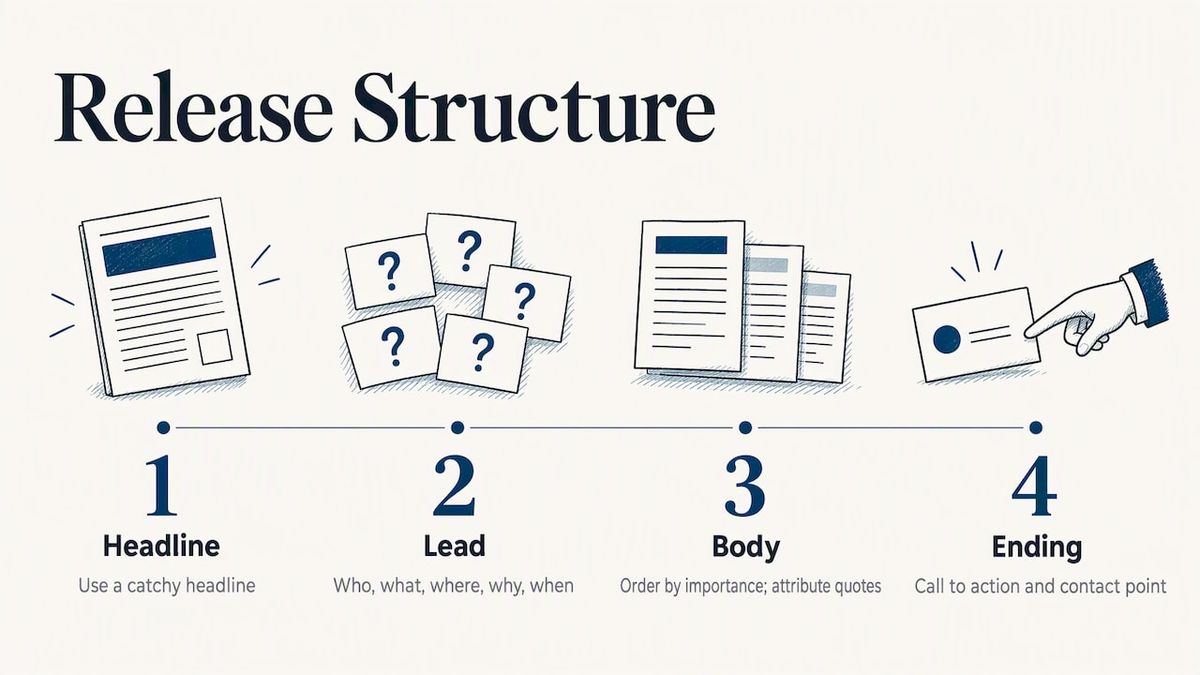
Australian guidance on media releases is consistent on structure. The Fisheries Research and Development Corporation's guide to writing a media release recommends a catchy headline, a lead that covers who, what, where, why and when, body paragraphs in order of importance with attributed quotes where possible, and an ending with a call to action and a contact point. A release is typically about one page, with the opening covering the same five questions.
The headline
Write it as a statement of news, not a slogan. Put the subject and the verb up front. Compare:
- Weak: "Exciting new chapter for BrightLedger"
- Stronger: "BrightLedger launches invoicing app for Australian sole traders"
The second tells an editor the company, the action, the product and the audience. (BrightLedger is an invented example for illustration.)
The first paragraph
The opening paragraph should work alone. If a journalist reads nothing else, they should know who is announcing what, when, where and why it matters. Put the place and date in the dateline, for example "Melbourne, 12 May", and keep the paragraph under about 40 words where you can.
The body
Order paragraphs by importance, not chronology. A sound pattern:
- The core news with the strongest fact or figure.
- The problem you solve and who has it.
- A founder or customer quote that adds opinion or context, not a repeat of the facts.
- Supporting detail: availability, pricing, partners, technology, how it works.
- A short "about" paragraph: what the company does, when it started, where it is based.
Keep quotes human. "We are thrilled to announce" tells nobody anything. A founder explaining why the product exists, or what a customer could not do before, is worth printing.
The ending
Close with a clear next step: a link to the product, a booking page for demos, or a request for interviews. Add a named media contact with a phone number and email who will actually answer. The FRDC guide also advises making sure you have the internal authority to issue the release and are ready to give interviews or more information if media call. If a journalist rings and nobody is available, the chance passes within hours.
A quick checklist before you publish
- Every claim has a number, a name or a document behind it.
- Jargon is explained or removed.
- Names, titles, dates and figures are checked by a second person.
- Links go to live pages.
- Images, logos and founder photos are attached or linked.
- It reads sensibly to someone outside your industry.
Announcing a launch
A launch release has to explain the problem before the product. Startup guidance from Believe Advertising suggests a startup story should highlight mission, values and the problem being solved, and that fits what journalists look for: a reason this thing exists now.
For the details, Shopify Australia's product launch guide recommends covering the product name and key features, visuals, a short company background, useful links, availability and pricing, and contact details for follow-up. In practice, that means a launch release should answer:
- What is it called and what does it do, in one sentence?
- Who is it for, and what problem does it remove?
- What is the one number or fact that proves traction or credibility, such as pilot users, a waitlist or a partner?
- Where and when can people get it, and at what price?
- Who built it, and why them?
If you are launching a mobile product, our guide to a press release for an app launch goes deeper on app-specific angles such as store availability, screenshots and early reviews.
Announcing funding
Funding is the second most common startup announcement, and it is the one where founders most often bury the useful detail. A funding release should state, near the top:
- the amount raised and the type of round (seed, Series A, grant, government-backed investment)
- who led it and who else took part
- what the money will be used for
- what the company has achieved so far that justified the raise
- what happens next, such as hiring, product milestones or expansion
Public investment announcements often put the purpose of the money front and centre. For example, the ABC reported that Harrison.ai received $32 million from the National Reconstruction Fund in a 2025 round, with the investment intended to help it keep basing its operations in Australia. The lesson for your own release is that a stated purpose and a clear tie to Australia give editors an angle beyond the cheque size.
A few cautions. Only name investors who have agreed to be named. Do not publish valuation figures unless you are comfortable with them being repeated everywhere. And keep forward-looking statements, such as plans to "become the market leader", clearly framed as your intentions rather than established facts. If you are a regulated business or raising from the public, check with your lawyer or adviser about what you can say before issuing anything.
Timing and preparation
Prepare before the announcement date, not on it. Startup PR guidance recommends avoiding weekends, major holidays and days dominated by big competing news, and having the media list, release and strategy ready in advance. In Australia, that includes checking the calendar for public holidays that differ by state, major sporting finals, federal budget days and election periods, when business news struggles for space.
A workable preparation timeline:
- Two weeks out: lock the story, agree the quotes and approvals, and build the media list.
- One week out: finalise the release, assemble the media kit, brief your spokespeople and line up any exclusive.
- Announcement day: send tailored pitches first, publish the release, post on your channels and monitor replies.
- Following days: follow up once with journalists who showed interest, and respond quickly to any interview request.
Build a media kit
A media kit reduces friction for reporters. According to MyPRPartner, it should hold high-resolution images, founder bios, logos and fact sheets, ready to share. Put it in a single shareable folder and link it from the release.
Give it an Australian angle
If your startup is global or based overseas, remember that local editors ask why Australians should care. Stone & Chalk advises that overseas activity is more likely to interest local media when the startup can explain its relevance or impact for Australians. Local customers, local jobs, Australian pricing or an Australian founder story all count.
Reaching the right journalists and outlets
The FRDC guidance gives three routes: choose relevant local or national outlets, build your own contact list, or use a paid media release service that can target the release. In practice, a good approach combines them.
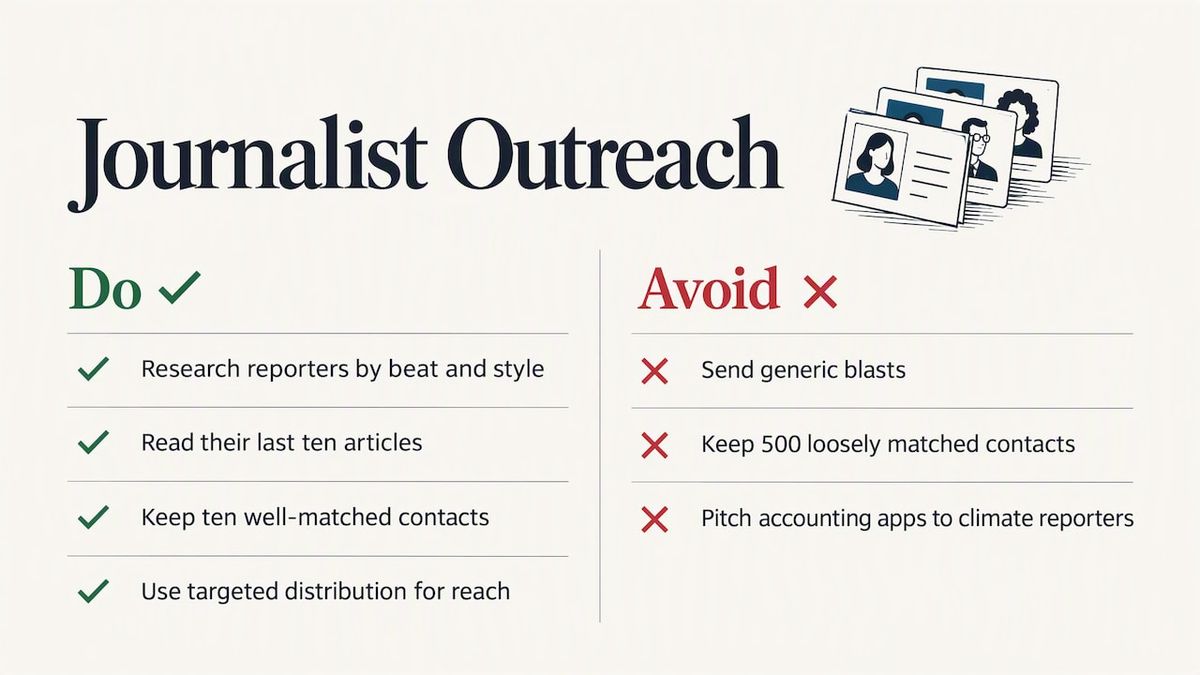
Research by beat. One practitioner view is that releases suit hard news with a headline-worthy hook, and that journalists should be researched by beat, publication style and deadlines instead of getting a generic blast. Read a reporter's last ten articles before you write to them. If they cover climate tech, do not send them your accounting app.
Keep the list small and current. Ten well-matched contacts beat 500 loosely matched ones. Group them by tier: the one outlet you would love an exclusive with, the trade titles in your sector, and the regional and local outlets near your head office or customers.
Use distribution for reach and permanence. A distribution service takes the release beyond the people you already know and gives it a lasting, searchable home. Our guides on how to send a media release in Australia and on press release syndication in Australia explain the options and what to expect from each.
Share it yourself. Post the release link on LinkedIn and your other channels, and tag partners and investors who are happy to be mentioned. We cover this in how to share a press release on social media.
Choosing a distribution service
When comparing services, judge them on what matters to a startup with a modest budget:
| Criterion | What to look for |
|---|---|
| Speed | How quickly your release goes live after you submit it, and how long review takes |
| Editorial standards | Whether releases are reviewed for accuracy and credibility, which protects your reputation |
| Search visibility | Whether the page is built so it can be found long after the announcement |
| Reach | Whether it covers Australian outlets and international ones if you need them |
| Pricing | Whether you can pay per release rather than commit to a subscription |
| Reporting | Whether you can see engagement so you can refine the next release |
Publishing with News Today
News Today is our press release distribution service for Australian businesses, startups, agencies and nonprofits. You submit your release, it goes through editorial review, and it is published on the platform and distributed to media networks. We aim for fast turnaround, with instant publication and a 24 to 48 hour review window, and the page is built for search visibility so your announcement stays findable. Submissions can include media-rich content, category targeting and a media list, and premium users get performance tracking.
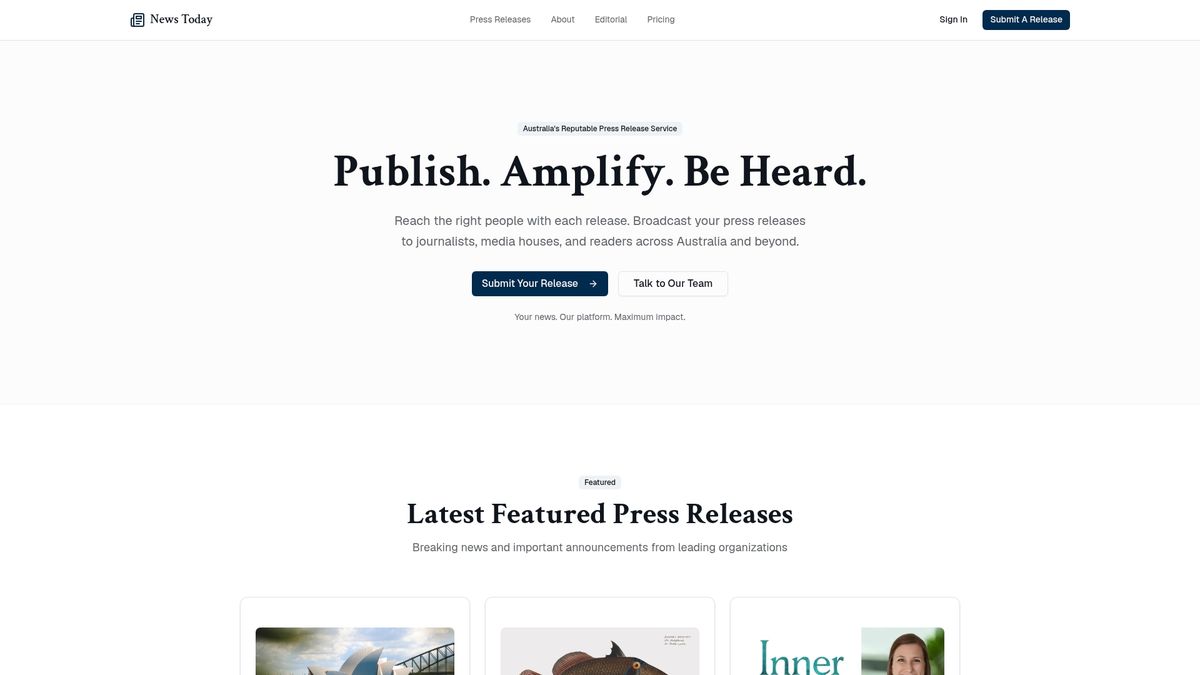
A single release costs $39, a one-off payment, so you can use it for one announcement without committing to a plan. If you are an agency or an enterprise with regular announcements, custom solutions are available. See pricing, read about our editorial standards, or go straight to submit your press release.
What results to expect
Be realistic. Media coverage is not guaranteed, because it depends on the story and the news cycle, as the FRDC guidance states. A release can give you a credible web page for your news, a link to share with investors and customers, and a chance that a journalist picks it up. It cannot make a weak story strong.
The benefits that are more within your control include awareness, legitimacy and referral traffic, which are the advantages Publicize lists for startups. To know whether yours worked, track a few things:
- visits to the release page and where they came from
- clicks to your site and sign-ups or enquiries that follow
- pickups by journalists and bloggers, and any new mentions of your brand
- search visibility for your company name in the weeks after
Our guides on press release analytics, earned media metrics and how to monitor brand mentions show how to measure and report these without drowning in dashboards. If you spot a mistake after publishing, see how to handle a press release correction.
Common startup press release mistakes
- Announcing non-news. A new website colour scheme or a minor feature rarely qualifies. Save the release for stories with a hook.
- Writing for investors instead of readers. Buzzwords like "disruptive" and "world-class" carry no information. Use facts.
- Burying the lead. If the news is in paragraph four, rewrite.
- Skipping the pitch. Publishing the release and waiting is the most common reason for silence.
- Having nobody to call. An unanswered media contact wastes the one chance you get.
- Ignoring the Australian angle. Global stories need local relevance.
- Sending on a bad day. Check the news calendar first.
Some startups work in a particular sector with its own audience. For example, an edtech founder will find useful angles in our guide to writing and distributing an education press release.
FAQ
How much does a startup press release cost in Australia?
The cost depends on the route you take. Writing it yourself costs only your time, while agencies charge for drafting and outreach. On News Today, a single release is $39 as a one-off payment, and custom packages are available for enterprise needs. Check the pricing page for the current offer.
How long should a startup press release be?
About one page is typical, which is roughly 300 to 500 words. The opening paragraph should cover who, what, when, where and why, and the rest should add a quote, key details, background and a contact point. Put extra material in a linked media kit rather than the release itself.
Does a startup need a press release for every announcement?
No. Use one when you have real news, such as a launch, funding, a major hire, an award or a significant new feature. For smaller updates, a blog post or social media is usually enough. A release sent without a clear hook is more likely to be ignored.
Will a press release guarantee media coverage?
No. Coverage depends on the story, the timing and the news cycle. A release gives journalists the facts and gives you a permanent page, but targeted pitching to relevant reporters is what usually moves it from announcement to article.
Sources
- Hypepotamus: When is your startup news worth a press release?
- Bender Group PR: Press Releases vs Earned Media
- Startup Daily: Startup storytelling
- FRDC: Guide to writing a media release (May 2024)
- PRLab: What Is a Press Release?
- Believe Advertising: The Ultimate Guide to PR for Startups in Australia
- Shopify Australia: How to Write a Product Launch Press Release
- ABC News: Harrison.ai and the $32 million investment
- MyPRPartner: How to Write a Press Release
- Stone & Chalk: A guide to public relations for tech startups
- Pure Public Relations: Is the press release dead?
- Publicize: Ultimate Startup Press Release Guide